







How you should think about ranking NHL all-time greats in 2026
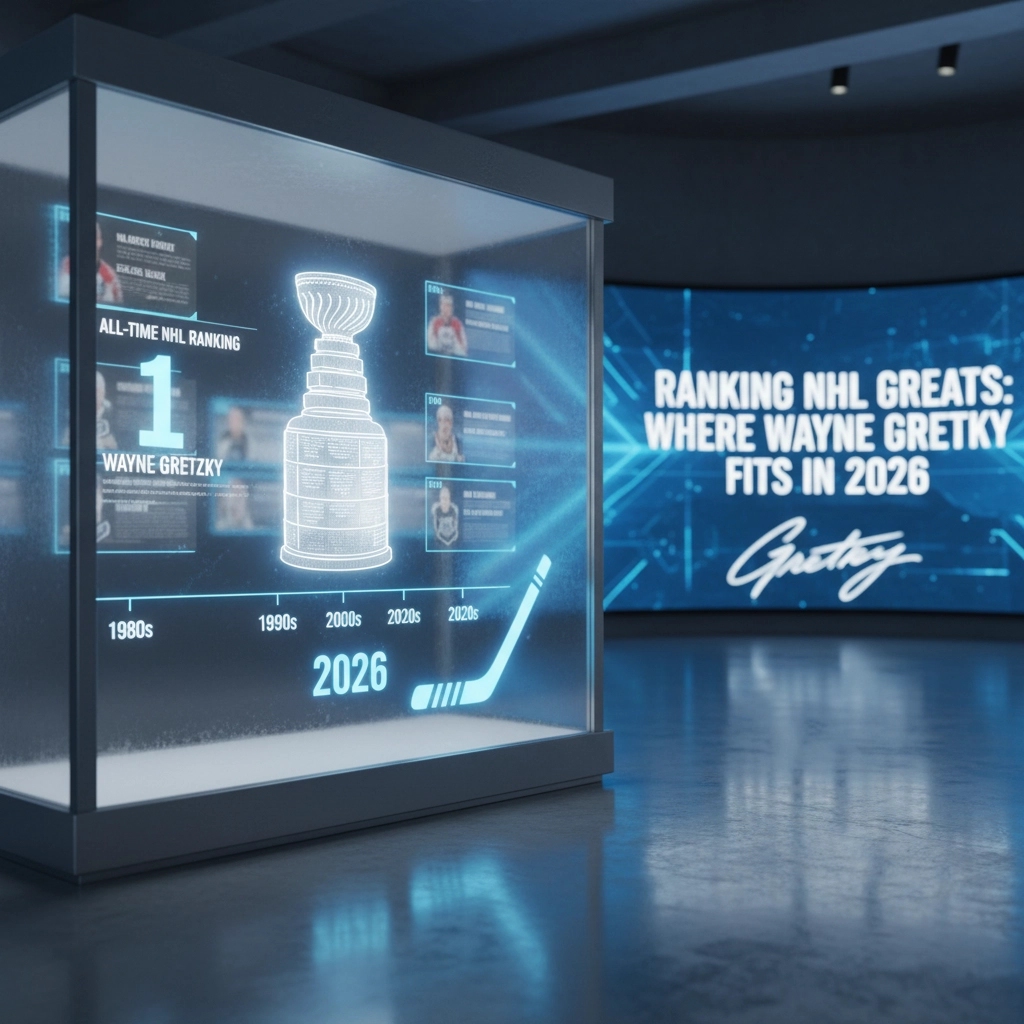
You already know Wayne Gretzky is a seminal figure in hockey, but ranking him against every era’s best requires more than a list of trophies. In 2026, the debate isn’t just nostalgic — it’s analytical. You’ll need to weigh raw statistics, the context of rule changes, and modern metrics that weren’t available during Gretzky’s career. This section frames the criteria you’ll use to evaluate his place among the game’s elite.
When you rank players, consider three broad pillars: accomplishment (awards, championships), dominance (records and peak seasons), and impact (how a player changed the game and influenced teammates). Each pillar matters differently depending on whether you value team success or individual brilliance. Gretzky’s resume demands attention across all three pillars, but how you prioritize them will affect his final position on your list.
Key reasons Gretzky remains central to any ranking discussion
- Unparalleled scoring totals: You’ll look at career points (goals + assists) and the frequency of 100-point seasons as clear evidence of dominance.
- Historical records: Gretzky’s single-season and career records set a benchmark that has influenced how you measure greatness.
- Game-changing presence: Beyond numbers, Gretzky altered defensive strategies, power-play schemes, and the star power of the NHL.
What Gretzky’s statistics and era context tell you
To place Gretzky accurately, you must parse his statistics alongside the era he played in. During the 1980s and early 1990s, scoring environments were different: you saw higher average goals per game and less specialized defensive systems. That doesn’t nullify Gretzky’s production — instead it shapes the lens through which you compare him to players from lower-scoring eras.
Look at both aggregate numbers and rates. Aggregates (like career points and goals) showcase durability and sustained excellence; rate stats (points per game, points per 60 minutes) help you adjust for era and games played. Gretzky leads overwhelmingly in aggregate categories, and his rate metrics remain elite even after adjusting for era by many modern methods.
Also keep in mind the evolution of equipment, travel, training, and analytics. You will find that some modern players benefit from specialized coaching, year-round conditioning, and detailed opponent scouting. Those factors can narrow gaps that once seemed insurmountable, yet they don’t erase historical dominance.
With this foundation — your criteria, the weight you give to records vs. rings, and the era adjustments you accept — you’re ready to compare Gretzky head-to-head with other candidates. In the next section, you’ll examine specific statistical and advanced-metric comparisons between Gretzky, his prime peers, and the top stars of the 2010s and 2020s to see how those matchups shape his 2026 ranking.
Statistical and advanced-metric matchups: Gretzky vs. the modern elite
Now you move from raw totals to comparative metrics that matter in 2026. Traditional counting stats still favor Gretzky — his career point total is a singular benchmark — but modern tools let you compare rate production, context, and impact per minute. When you look at points-per-60 (P/60) and era-adjusted P/60, Gretzky’s numbers remain elite: even after normalizing for the higher-scoring 1980s, his offensive rates typically sit at the top or near the top of any all-era list.
Advanced metrics you’ll use include:
– Points-per-60 at even strength and on the power play, to separate PP inflation from 5-on-5 dominance.
– Relative possession measures (CF% rel, xGF% rel) that show whether a player lifted his teammates’ play.
– Wins Above Replacement (WAR) / Goals Above Replacement (GAR) estimates that aggregate offense, defense, and contextual replacement value.
What these reveal in 2026: Gretzky scores like no one else historically on rate terms, but some modern stars — notably those in their primes with weak supporting casts — can approach or even exceed him in short-term WAR slices because of better two-way play and possession dominance. Conversely, when you isolate pure playmaking and chance creation per hour, Gretzky’s top-tier seasons still compare favorably with the best single-season peaks of McDavid or Crosby. The nuance is critical: Gretzky’s ceiling is historically unmatched, but a modern player’s peak can look more complete in puck-possession and defensive-impact metrics that weren’t tracked in his day.
Playoffs, championships, and team context: how they tilt the scale
You can’t ignore team context. Gretzky’s four Stanley Cups with Edmonton are an important counterweight to any argument that prioritizes rings above all else. Still, championships are a team accomplishment and depend heavily on goaltending, depth, and luck — variables that analytics try to separate from individual value.
When assessing Gretzky alongside other contenders, ask:
– Did that player elevate his teammates in the postseason, and is there quantitative evidence of that in playoff P/60 or on-ice goal differential?
– Was his team constructed to maximize his skill set (power play-first systems, quality linemates), or did he produce despite a limiting structure?
In Gretzky’s case, both apply. His teams were built around his vision and playmaking, amplifying his counting stats; yet he also consistently improved team outcomes in the regular season and playoffs. For modern players, you’ll see more balance: some superstars carry weaker teams into deep playoff runs, while others collect regular-season hardware but have limited postseason resumes. That tension — individual dominance versus team success under different roster constructions — is one of the main reasons Gretzky’s placement remains a subject of serious debate in 2026.
Peak dominance versus longevity: how to weigh a brilliant peak against sustained excellence
Finally, decide how you value peak seasons relative to career length. Gretzky’s extraordinary peaks — multiple seasons that redefine “dominant” — make a compelling case if you prize transformative years. But modern analytics also reward players who maintain elite play over a longer window, especially when that play includes defensive responsibility and puck possession.
If you favor peak dominance, Gretzky’s case becomes nearly unassailable. If you favor a balanced, era-adjusted composite of peak and longevity — weighted by two-way value and replacement cost — some modern candidates climb closer to his level. Your ranking in 2026 will depend on which lens you choose: the breathtaking apex of a single player or the sustained, multi-dimensional excellence that analytics increasingly highlight.
The lasting debate and the path forward
Arguments about all-time rankings are as much about values as they are about numbers. In 2026, the tools at our disposal let us interrogate Gretzky’s achievements with greater nuance than ever, but they don’t remove taste, context, or what you personally prize in a player. Expect the debate to continue: new tracking data, evolving defensive metrics, and the next generation of superstars will all influence how historians and fans place Gretzky on the all-time list. If you want a place to explore up-to-date league stats and historical splits as you form your own view, check the NHL Stats portal.
Frequently Asked Questions
Does modern analytics make Gretzky less dominant?
No — modern analytics change how we describe dominance. They allow more precise separation of context, defensive impact, and possession, which highlights areas where modern players may have advantages. But Gretzky’s rate scoring and playmaking remain historically exceptional even when adjusted for era and context.
How should championships factor into all-time rankings?
Championships matter but are not decisive on their own. Stanley Cups reflect team construction, goaltending, and variance; they should be weighed alongside individual impact metrics (playoff P/60, on-ice goal differential) and the player’s role in generating team success.
Can a modern player ever “surpass” Gretzky in these rankings?
Yes, depending on criteria. If you prioritize two-way play, possession dominance, and era-adjusted WAR over raw point totals, a modern player could be ranked above Gretzky. If you emphasize transcendent peak scoring and playmaking, Gretzky remains exceptionally difficult to displace.