








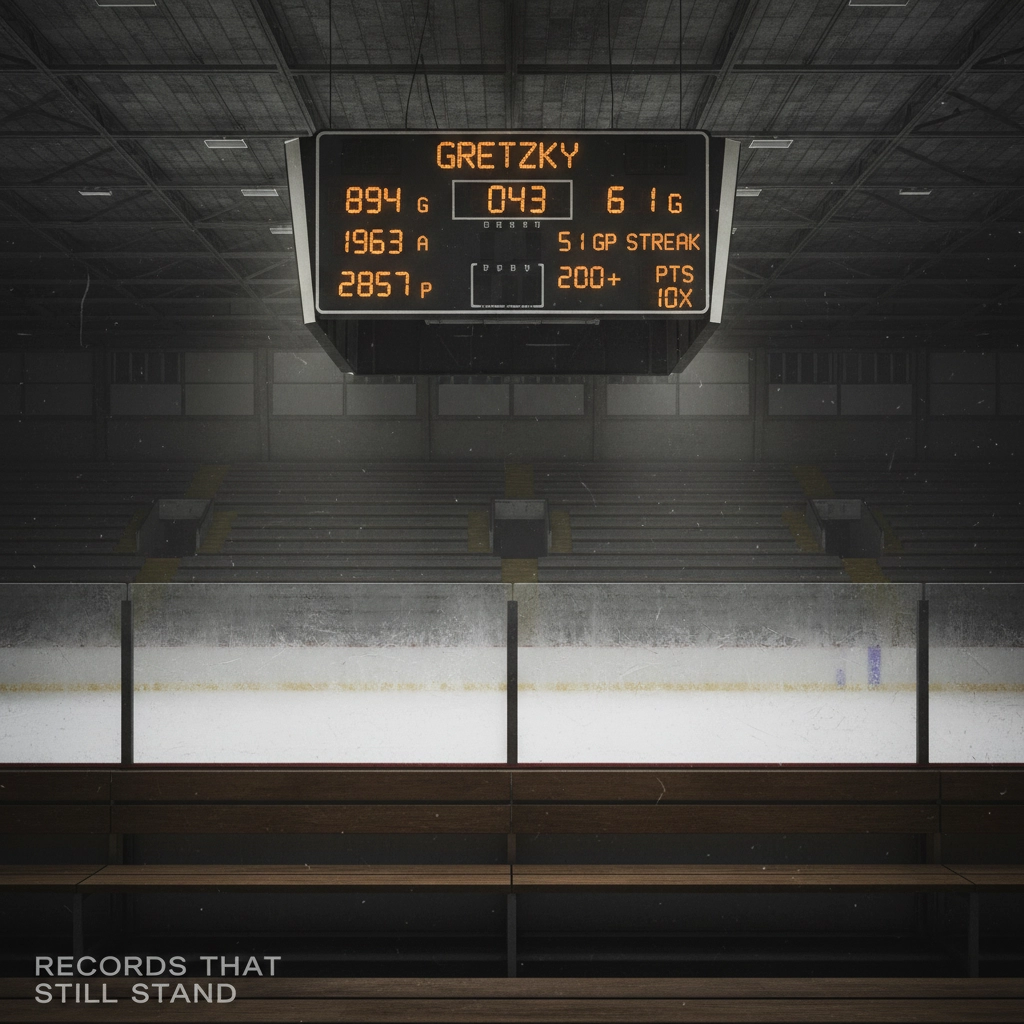
Why Wayne Gretzky’s Records Look Unbelievable When You Open the Record Book
When you flip through NHL history, certain entries leap off the page: numbers so large they redefine what “dominant” means in hockey. Wayne Gretzky, nicknamed “The Great One,” set records that didn’t just push the bar — they moved it to a different neighborhood. You’ll quickly see why casual fans and statheads alike call many of his marks untouchable: they combine outrageous individual skill, sustained excellence, and an era of hockey that allowed offensive fireworks.
Understanding why these records still stand helps you appreciate both Gretzky’s genius and the structural changes in the game since his prime. Rule changes, better goaltending and equipment, defensive systems, and even roster parity all influence how modern players chase milestones. Still, some of Gretzky’s achievements are so far outside the norm that they resist trend shifts — and that’s what this series will unpack, starting with the feats that announced his arrival and rewrote the statistical map.
Early-career feats that forced the NHL to rewrite its record pages
Gretzky’s remarkable run began in the late 1970s and exploded in the 1980s. These early-career numbers didn’t just hint at future greatness — they immediately established new standards. Below are a few of the most striking early marks and why they remain astonishing to this day.
-
Fastest to 50 goals: 50 in 39 games (1981–82)
Scoring 50 goals in a single season is a celebrated milestone; doing it in 39 games is otherworldly. When you consider the defensive attention a player like Gretzky drew, his pace to 50 goals that year shows how he could create space and finish with clinical precision.
-
Single-season goal high: 92 goals (1981–82)
Gretzky’s 92-goal campaign stands as the single-season goal record. You can track every era’s leading scorers, and very few come close to this total — a reminder that seasonal goalscoring ceilings have dropped for most superstars in the decades since.
-
Single-season assists and points that redefined playmaking: 163 assists and 215 points (1985–86)
Assist totals of this size suggest not just personal skill but an ability to elevate teammates game after game. The 163 assists and 215 points in one season are benchmarks in playmaking and overall offensive production — numbers you rarely see even in the highest-scoring modern seasons.
-
Early award dominance: multiple Art Ross and Hart Trophies
Gretzky’s run of scoring titles and MVPs early in his career signaled sustained superiority, not a single hot streak. Those award tallies set a precedent for what “dominance” looks like over multiple seasons.
Each of the records above tells two stories: one about Gretzky’s unique talents and one about how the NHL has evolved. In the next section, you’ll dive deeper into the career-long totals and season streaks that continue to baffle modern scorers and analysts.
Career totals that still tower over the modern leaderboard
When you step back from single seasons and look at the ledger of an entire career, Gretzky’s entries don’t just sit at the top — they dominate the page. He retired as the NHL’s all-time leader in goals (894), assists (1,963) and points (2,857). Those aren’t incremental leads you chip away at over a few decades; they’re cumulative plateaus built from relentless production and an almost surreal consistency.
Part of what makes those totals so unassailable is the rate at which he accumulated them. Across two decades in the league, Gretzky averaged just under two points per game — a pace that modern stars only flirt with in small samples, not as a career baseline. He combined elite finishing with extraordinary vision, which translated into more assists than goals by a wide margin: Gretzky’s role as a playmaker amplified teammate production as well as his own totals. Add in his longevity — playing deep into his 30s at a high level — and you see why his totals feel less like records and more like historical landmarks.
Another factor is how those counts compound. Modern seasons are longer, analytics and training are more advanced, and yet nobody has compiled the same blend of peak seasons and dependable year-to-year production to close the gap. Even the greatest contemporaries have approached discrete parts of Gretzky’s résumé — a monster goal season here, a lengthy points streak there — but not the full, sustained accumulation across goals, assists and total points.
Streaks and season-long runs that read like fiction
If totals are mountains, Gretzky’s streaks are avalanche stories. One of the most arresting is his 51-game point streak — more than half a season in which he recorded a point in every outing. That kind of uninterrupted production is rare in any era; sustaining elite performance week after week against professional opposition requires not only skill but an ironclad competitive and physical resilience.
Beyond single streaks, Gretzky produced unbroken runs of excellence that span entire seasons and then some. He posted consecutive seasons with eye-popping point totals and stacked 50-goal and 100-point years with regularity, turning what would be a career highlight for most players into his baseline. Those runs were not isolated to a single team or a single system; Gretzky continued to pile up results even as rosters and situations changed, which underscores the individual nature of many of his marks.
What elevates these runs from “impressive” to “unbelievable” is the combination of frequency and longevity. Modern stars can string together elite stretches, but maintaining that intensity across multiple seasons, and doing so while opponents made tactical adjustments specifically to stop you, is where Gretzky’s streaks become historically exceptional.
Why the modern game makes many of these records so durable
It’s one thing to name the records; it’s another to understand why they’re resistant to being broken today. Over the last three decades the NHL has evolved: defensive systems are more sophisticated, goaltending technique and equipment have improved dramatically, and coaching emphasis on structure and matchup defense reduces the kind of open-ice creativity that fueled many of Gretzky’s assists. Free agency, salary caps and roster parity also spread elite talent across more teams, which makes the singular concentration of scoring power less likely.
Combine those structural shifts with Gretzky’s unique blend of skill, vision and endurance, and the result is a set of marks that are not just historically large but contextually protected. That’s why when you look at the record book now, Gretzky’s name doesn’t just appear — it sits on top of its own skyline.
The lasting imprint of greatness
Records do more than mark numerical superiority — they shape the narrative of a sport. Gretzky’s marks function as reference points for talent, ambition and the evolution of hockey itself. They force every generation to measure both skill and context, and they ensure that debates about the “best ever” remain rooted in something tangible. For those wanting to explore the raw numbers behind the mythology, the official NHL stats provide the play-by-play of how exceptional those lines truly are.
Frequently Asked Questions
Which of Gretzky’s records are most likely to be broken?
Some single-season marks are more vulnerable than lifetime totals, but even those are steep targets. Modern defensive systems and goaltending improvements make single-season points and assist records difficult to surpass, and career records like goals, assists and total points are especially unlikely without an unprecedented combination of peak production and longevity.
How have changes in the NHL affected the durability of Gretzky’s marks?
Rule changes, improved goaltending technique and equipment, defensive coaching, salary cap-driven parity and roster depth have all reduced the frequency of extremely high individual scoring. Those structural shifts mean extraordinary single-player accumulation is rarer today than in the eras when some of Gretzky’s records were set.
Could any active player realistically approach Gretzky’s career totals?
It would take an extraordinary and sustained level of production across many seasons to approach Gretzky’s career totals. While elite players can threaten individual-season numbers, matching his career accumulation would require both long-term health and a consistently elite scoring rate over decades — a combination that remains highly improbable.