








How playoff intensity and matchups reshape NHL player prop opportunities
When the NHL calendar flips to the playoffs, the game you think you know changes. You’ll see tighter systems, different usage patterns, and fewer scoring chances per game — all of which directly affect player prop lines and payouts. In the postseason, coaches shorten benches and lean heavily on top lines and specialty units. That means the same player prop you wagered on during the regular season (shots, goals, assists, time on ice) can move dramatically as matchups, injuries, and game scripts evolve.
Understanding those changes is the first step in turning player props into consistent profits rather than one-off guesses. This section explains the causal shifts you must monitor and how they influence sportsbook lines.
Why situational context matters more than raw totals in playoffs
- Matchup-driven minutes: You’ll often see minutes concentrated on a handful of players — top-six forwards and top-four defensemen. If you can identify who’s getting more power-play time or defensive-zone starts, you can anticipate prop line movement.
- Game script volatility: Playoff games swing between tight trap games and wide-open affairs. Teams protecting a lead will clog the neutral zone, suppressing shot and scoring props; trailing teams will generate more rush opportunities.
- Goaltender impact: Hot goalies can turn goal-scoring props into long shots; conversely, facing a struggling netminder greatly increases the value of over-goals and shots props.
Fundamentals: reading player prop lines, odds, and implied payouts
Before placing bets, you must read the market. A prop line is a sportsbook’s estimate of an outcome — for example, “Player A over 0.5 goals” or “Player B over 3.5 shots.” Odds attached to that line convert the sportsbook’s estimate into a payout. You should translate those odds into implied probability, then compare that probability to your own assessment based on available data.
Quick checklist for evaluating a prop’s value
- Convert decimal or American odds to implied probability so you can judge fairness.
- Compare the line to recent usage: time on ice (TOI), power-play minutes, and average shots per game over the past 5–10 games.
- Factor in matchup data: opponent’s penalty kill, goaltender save percentage, and defensive scoring chances allowed.
- Monitor line movement and market consensus — early lines often offer better value before sharp bettors move the market.
By combining game-state awareness with basic probability conversion, you’ll start to separate playable props from overpriced ones. In the next section you’ll examine the main player prop categories — goals, assists, shots, time on ice, and goalie props — and learn how to model each with practical examples and payout calculations.
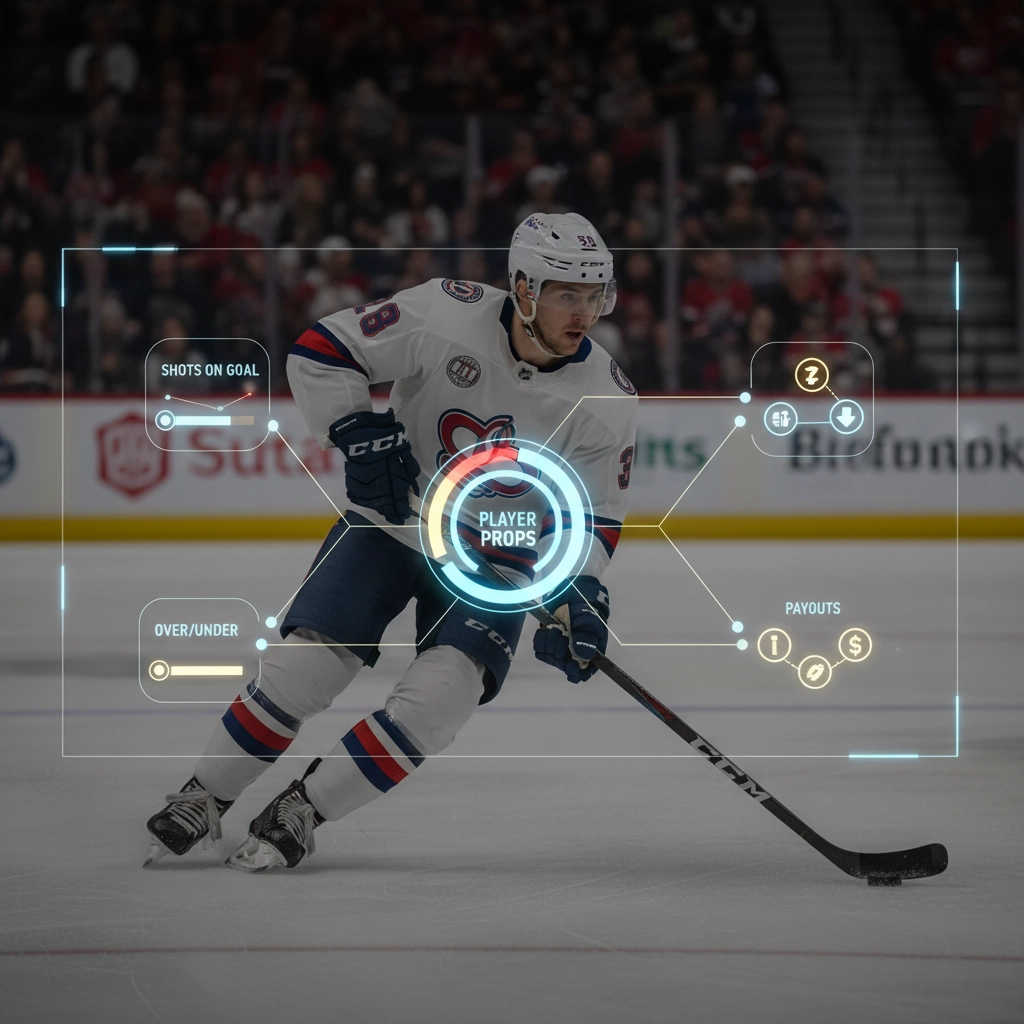
Modeling skater props: goals, assists, and shots
In the playoffs, treat goals, assists and shots as separate modeling problems driven by usage and matchup adjustments rather than raw season averages. Start by creating a short-window baseline (last 5–10 games) and then adjust for playoff factors: power-play share, expected line deployments against the opponent, and whether the team is likely to play a lead-or-chase script.
A simple, practical approach:
– Estimate a player’s lambda (expected events per game) from recent rates: shots/game, primary-assist rate, or goals/game. Weight recent usage higher than long-term averages.
– Adjust lambda for matchup: reduce expected goals when facing an elite hot goalie, increase when opponent allows high-danger chances or has a weak penalty kill.
– Convert lambda into a probability for discrete props. For “player scores at least one goal” use the Poisson complement: P(goal ≥1) = 1 − e^(−λ). For shots or assists, the same Poisson framework approximates probabilities for hitting integer thresholds.
Example: Player X has an adjusted expected goals value λ = 0.45 on a given night (higher TOI + more PP time). Probability he scores at least once = 1 − e^(−0.45) ≈ 36%. If the market lists “Player X over 0.5 goals” at American odds +150 (implied probability ~40%), your model says ~36% — not a value bet. If odds drift to +200 (implied ~33%), the market becomes +EV.
Payout math primer (applied): For a $100 stake at +150, return = $250 (profit $150). Expected value = model_prob payout − (1 − model_prob) stake. Using the numbers above: EV = 0.36250 − 0.64100 = $90 − $64 = +$26 (per $100) if your probability were correct and the market were +150.
For shot props, use shots/game as λ and apply the Poisson CDF to calculate P(≥N). If a player averages 3.8 adjusted shots, the chance of hitting 4+ shots is materially higher than a baseline 3.2, and that difference is where value hides — especially when line movement lags usage reports or when public habits overvalue shooting stars on hot streaks.
Time on ice and goalie props: usage-driven edges and payout examples
Time on ice (TOI) is often the most straightforward prop to model because coaching decisions drive it. Build a TOI distribution from recent games and account for matchup-specific deployment: heavy defensive assignments, line-matching, or extended power-play minutes. If a player normally logs 17–19 minutes but is now on the top power-play unit and expected to play 20–22, a prop line of 18:30 becomes attractive.
Example TOI EV: model predicts 60% chance the player exceeds 18:30. If the market offers -110 (implied ~52.4%) for the over, your edge is 7.6% on probability. For a $100 bet, expected value = 0.60190 − 0.40100 = $114 − $40 = +$74.
Goalie props require pairing team shot-volume forecasts with the goalie’s save percentage. Expected saves = opponent shots on goal × goalie save%. To estimate a goalie’s chance to exceed a saves line or record a shutout, adjust shot-volume by playoff game script (trailing teams push shots) and account for variance — hot goaltending spikes are common in short series.
Example goalie save prop: opponent projected to fire 32 SOG, goalie has .915 SV% => expected saves ≈ 29.3. A line of over 26.5 saves is favorable if you model a high shot total and a league-average variance that keeps probability above the market’s implied odds.
Across all prop types, the workflow is the same: build an expected-rate model, compare the model probability to implied market probability (convert odds to implied %), and only pull the trigger when your probability exceeds the market’s by enough to overcome vig.

Putting models into practice
Turning the modeling techniques above into a repeatable advantage comes down to discipline, information flow, and risk control. Keep models simple, update inputs quickly (lineups, power-play assignments, goalie starts), and shop multiple books for the best price. Use trusted analytics sources like HockeyViz to validate matchup and expected-chances data, but let your model — not the narrative — determine whether a prop is playable.
- Prioritize short-window, usage-driven inputs over full-season aggregates.
- Compare your implied probability to the market after converting odds; only wager when you have a measurable edge.
- Size bets to both edge and variance: small, consistent stakes preserve capital through the playoffs’ high volatility.
- Track every bet, outcome, and model adjustment so you can iterate and improve over time.
Frequently Asked Questions
How do I convert sportsbook odds into an implied probability?
For American odds: if odds are positive (+X), implied probability = 100 / (X + 100). If odds are negative (−Y), implied probability = Y / (Y + 100). For decimal odds, implied probability = 1 / decimal_odds. Always account for vig — compare your model probability to the vig-adjusted market probability when assessing value.
Can I rely on regular-season stats for playoff prop bets?
Regular-season stats provide context but are often misleading in the playoffs. Prioritize recent usage (last 5–10 games), special-teams deployment, matchup-specific deployment, and goalie form. Adjust rates for coaching strategy changes and series dynamics rather than applying raw season averages unmodified.
What bankroll strategy is appropriate for NHL playoff player props?
Because of high variance in props during short playoff series, use conservative sizing: flat bets of 1–2% of your bankroll or a fractional Kelly approach (e.g., one-quarter Kelly) are common. Keep individual bet sizes small, avoid chasing losses, and maintain a record to evaluate long-term ROI.