








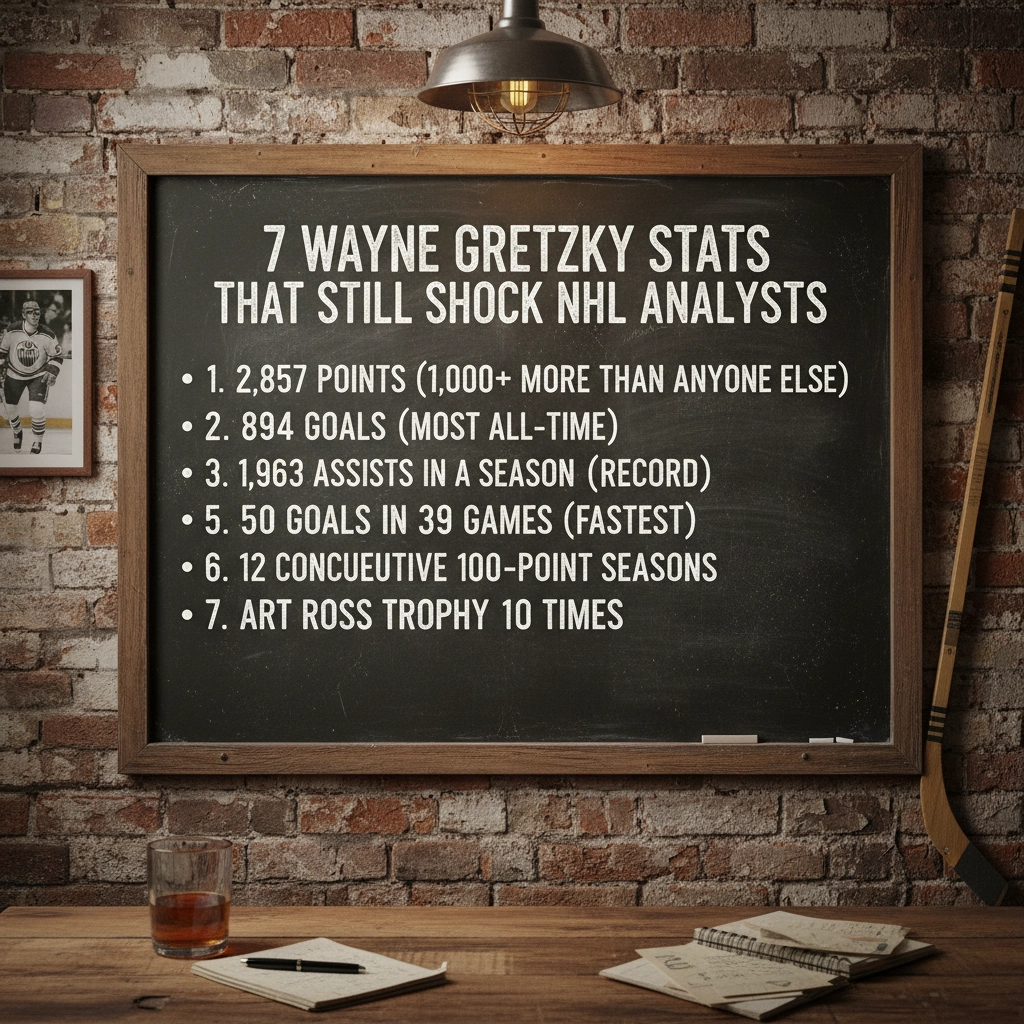
Why Wayne Gretzky’s numbers still feel unreal when you look closely
When you study NHL history, a few names come up again and again, but Wayne Gretzky’s statistical footprint is in a category of its own. As you read NHL stat lines now — shot totals, expected goals, time on ice — it’s easy to forget that one player once rewrote every scoreboard category so radically that future generations treat his numbers like benchmarks from a different sport. These are not just records you can point to; they change how you interpret player value and season performance.
In this first part, you’ll get acquainted with the foundational Gretzky figures that define his legacy. These stats aren’t just impressive; they shift expectations. You’ll see how one player’s season and career outputs dwarf what most great players achieve over entire careers. That gap is the reason analysts still use Gretzky as a comparative baseline when they say a season is “historic” or a player is “generational.”
Stat 1 — 2,857 career points: an almost untouchable lifetime total
Gretzky finished his NHL career with 2,857 regular-season points. To put that in perspective, no other player has even surpassed 2,000 points. When you compare career totals, Gretzky’s number isn’t just the best by a little — it’s in a different stratosphere. It compresses decades of league context, rule changes, and evolving styles of play into a single metric that still forces analysts to recalibrate expectations about what a “career of excellence” looks like.
Part of what makes that total so instructive is how consistent he was: you don’t get near 2,857 by having a handful of great seasons and then tailing off. You get there by being dominant year after year, which complicates any effort to map his career onto the modern game’s career arcs.
Stat 2 — 1,963 career assists: a helper total that redefines playmaking
Out of those 2,857 points, 1,963 were assists. In other words, Gretzky created almost 2,000 scoring chances that directly resulted in goals. That assists total alone exceeds the entire point totals of many Hall of Fame forwards. When you look at playmaking metrics and the value of creation today, Gretzky’s assist column forces you to ask whether modern analytics can fully capture the impact of vision, positioning and anticipation that his game embodied.
Single-season feats that still make modern stat models pause
Stat 3 — 215 points in one season (and the 163 assists that came with it)
Gretzky’s single-season record of 215 points (set in 1985–86) is paired with an astounding 163 assists in the same year. When you analyze seasonal peaks in the modern era, no one even approaches those numbers with the regularity Gretzky posted. If you break the 215 down, it becomes clear it was not a fluke of one dimension of his game — he combined goal-scoring instincts with world-class setup ability.
- Season: 1985–86 — 52 goals, 163 assists, 215 points.
These figures are why you still hear analysts say “you could pencil in X points” when referencing elite players — because Gretzky once made astronomical totals look attainable in a single season.
Next, you’ll examine some of Gretzky’s single-game and seasonal outliers — the individual performances that made analysts question whether the sport was changing or if they were simply watching something unprecedented.
Stat 4 — 92 goals in a single season: a record that still looks like a glitch
In 1981–82 Gretzky set the single-season goals record with 92. That number alone is jarring because it feels like a stat from another era — not just high, but so far beyond what elite finishers produce today that it forces you to rethink how the game measured offense. Modern 50–40–90 seasons and 60–goal outbursts draw headlines; 92 feels like a different sport. Analysts who build models around shot volumes, conversion rates and power-play structure still stumble when asked to project a season anywhere near that level.
Part of why 92 endures is context: the season combined Gretzky’s finishing touch with relentless creation from his teammates and an offensive environment that he often dictated. But even when you adjust for era and team quality, the raw total remains an extreme outlier — a single-season ceiling so high that it warps distributions in historical comparisons. That’s why when you show a young player’s 50–goal pace to an analyst, the immediate mental comparison is to Gretzky’s 92, not to any modern benchmark.
Stat 5 — 50 goals in 39 games: redefining “pace” in goal-scoring
More than the final tally, Gretzky’s speed to it is what rattles stat heads. He reached 50 goals faster than anyone had since Maurice Richard’s famed pace, doing so in just 39 games during that same 1981–82 campaign. Pace metrics are core to modern projections, but Gretzky’s sprint to 50 obliterated the assumptions those models make about scoring rate sustainability.
To an optimizer that expects regression to the mean, 50 in 39 looks unsustainable almost immediately. Yet Gretzky sustained unprecedented per-game production across multiple stretches of his career. That combination — blistering short-term pace plus long-term durability — is what makes his scoring seasons so poisonous to predictive models. Analysts must build in special-case allowances for a player who could turn a hot streak into an entirely new statistical norm.
Stat 6 — 10 scoring titles and 9 MVPs: the awards haul that quantifies sustained supremacy
Numbers on the scoresheet are one thing; trophies are another measure of dominance, and Gretzky’s hardware haul is almost as staggering as his point totals. He won the league scoring title (Art Ross) 10 times and the Hart Trophy as MVP 9 times — including eight in a row. Those awards aren’t just shiny punctuation on seasons; they’re repeated market validation that across contexts, rule sets and teammates, Gretzky was the central value generator in the league.
For analysts who try to separate individual contribution from team effects, this consistency makes Gretzky’s case airtight. It’s not just that his counting stats were enormous — it’s that voters and peers repeatedly recognized him as the single most impactful player in the league. That kind of multi-year consensus reinforces statistical signals and complicates any argument that his numbers were merely products of system or era.
Stat 7 — 2,857 career points: an aggregate that rewrites the record book
Gretzky finished his NHL career with 2,857 points — a cumulative total that functions less like a tally and more like a different measurement system. Career totals inherently reward longevity, but Gretzky combined durability with such extraordinary year-to-year production that his aggregate sits far above what even the greatest peers compiled. For analysts who model career trajectories, that total exposes limits in typical aging curves and cumulative-value projections.
Beyond the headline, the number forces deeper questions about how we compare players across eras: do we weigh peak seasons or sustained accumulation? Gretzky forces analysts to account for both because he gave them extremes of each. His career point total remains the single clearest statistical argument that some careers are not merely better — they operate on another scale entirely.
The lingering surprise of Gretzky’s numbers
Stats can be parsed, adjusted and fed into ever-more-complex models, but Gretzky’s records continually nudge analysts toward humility. Whether it’s a single-season outlier like 92 goals, an absurd single-season pace, a haul of trophies or a career total that few can even conceptualize, his numbers do more than top lists — they bend the assumptions behind those lists. For anyone trying to predict what comes next in hockey, Gretzky’s legacy is a persistent reminder that singular talent can create statistical phenomena that require new frameworks, not just tweaks to old ones. For more on his career and honors, see the Hockey Hall of Fame.
Frequently Asked Questions
Are any of Gretzky’s records realistically breakable?
Most analysts consider many of his single-season and career records extremely unlikely to be broken under modern conditions. Changes in league structure, defensive systems, goaltending, and player usage make seasons like 92 goals or career totals in the thousands highly improbable. That said, extraordinary outliers are always possible in sport, just rare.
Which Gretzky stat causes the most headaches for analytics models?
There’s no single answer, but the combination of peak rates (like 50 goals in 39 games) with sustained accumulation (multiple seasons leading to a 2,857-point career) is especially problematic. Models that expect regression, stable variance, or predictable aging struggle to accommodate both extremes simultaneously.
How do analysts adjust when comparing Gretzky to modern players?
Analysts typically use era adjustments (league scoring rates, goaltender save percentages, power-play frequency) and rate-based metrics to normalize comparisons. Even after adjustments, Gretzky often remains an outlier, so analysts sometimes create special-case models or confidence intervals that acknowledge the possibility of a truly singular talent skewing results.