







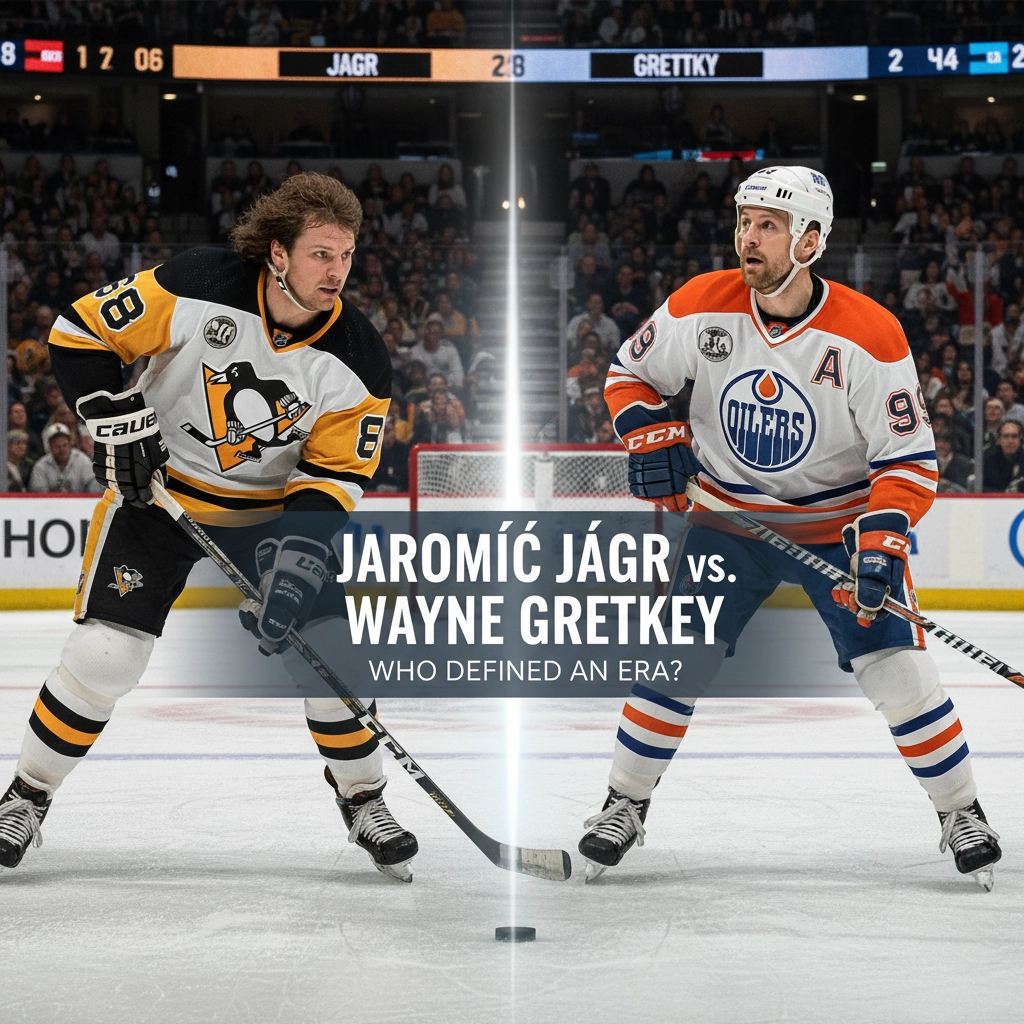
When Two Generations Collided on the Ice
You’re about to trace how Jaromír Jágr and Wayne Gretzky came to symbolize very different chapters in hockey history. At first glance, you can see why comparisons persist: both are among the sport’s most prolific scorers, both carried enormous expectations, and both became cultural icons beyond the rink. Understanding which player “defined an era” requires you to look past headlines and examine context—league structure, team construction, media reach, and international influence—because numbers alone won’t tell the whole story.
Why comparing eras matters for your perspective
When you compare Jágr and Gretzky, you’re comparing not just two players but two hockey landscapes. Gretzky rose to prominence in the late 1970s and dominated the high-octane NHL of the 1980s. Jágr’s ascendance in the 1990s and 2000s occurred amid expansion, changing defensive systems, and increased European influence. As you read on, keep in mind that era-defining status depends on on-ice production, stylistic influence, and the broader cultural footprint each player left behind.
How Jágr and Gretzky Broke into the NHL
To understand who defined an era, you need the early-career facts. Looking at their first seasons and breakout years gives you insight into how they set expectations for what was possible on the ice.
- Wayne Gretzky (early rise): You’ll note Gretzky’s swift impact in the WHA and then the NHL was immediate—extraordinary point totals, playmaking vision, and a rapid accumulation of league records that reoriented offensive benchmarks.
- Jaromír Jágr (NHL entry and breakthrough): Jágr arrived from Czechoslovakia as part of a wave of Eastern European talent. His size, puck protection, and scoring touch made him a building block for the Pittsburgh Penguins, where he helped transform the team into a perennial contender.
- Contextual differences you should weigh: Gretzky’s rise came before major league-wide defensive tightening; Jágr navigated a league shifting toward systems, neutral-zone traps, and more parity due to expansion.
Key early milestones to orient your comparison
As you review early milestones, focus on how each player’s first big seasons reshaped expectations. Gretzky’s record-setting point totals quickly rewrote what you considered a “great season.” Jágr’s early dominance, including top scoring and playoff success, signaled that European players could anchor a franchise and thrive in North America’s physical game. You should also consider how each player’s early acclaim affected team-building choices around them—coaches, linemates, and even front-office strategies often adjusted to maximize their strengths.
How their early styles hinted at long-term impact
From the outset, playing style offered clues about legacy. When you watch tape or study contemporaneous accounts, Gretzky’s anticipation and court-vision-style playmaking contrasted with Jágr’s combination of power, puck possession, and clutch finishing. These stylistic differences influenced teammates, coaching approaches, and even youth development philosophies in different regions.
Next, you’ll dig into peak statistical seasons, head-to-head matchups, and the cultural ripple effects that will help you weigh who truly defined a hockey era.
Peak seasons that reframed what “dominant” looked like
When you measure era-defining impact, peak seasons matter because they reset expectations for peers and opponents. Gretzky’s early- and mid-1980s runs—most famously his 1981–82 campaign that still stands out as one of the most improbable scoring seasons in history—forced teams to rethink defense, personnel, and how to build a roster around an all-time playmaker. Those seasons produced not only gaudy totals but a new baseline for elite offense: if you wanted to be elite, you had to account for someone who saw the ice differently.
Jágr’s peaks came in a fundamentally different environment. His mid-1990s dominance—highlighted by a season where he led the league in scoring and repeatedly finished at or near the top of leaderboards—proved that a physically imposing, European-trained forward could be the center of a North American power game. Jágr’s scoring felt less exotic than Gretzky’s vision; it was an affirmation that size, board play, and puck possession combined with high-skill finishing could carry a team in an era growing more structured and defense-first.
Put another way: Gretzky’s peaks expanded what offense could be, creating statistical plateaus others chased. Jágr’s peaks recalibrated how teams valued a tall, skilled winger in the modern roster mix—someone who could tilt possession, wear down defenders, and deliver in clutch moments. Both rewrites mattered, but they changed different axes of the hockey blueprint.
Head-to-heads and playoff narratives that tested legacies
When Jágr and Gretzky shared ice, their contrasts were instructive. Gretzky’s game forced you to account for space and passing lanes; Jágr’s presence demanded physical matchups and disciplined coverage. These were not just stylistic differences but tactical puzzles coaches had to solve when planning matchups.
Playoff context sharpens legacy, and here the stories diverge. Gretzky’s dynasty with the Oilers—four Stanley Cups—cemented a narrative of transcendent leader and centerpiece of a championship machine. Jágr’s early-career playoff success, including back-to-back Cups in the early 1990s, established him as a winner and a franchise-defining piece. Over the long run, however, Gretzky’s playoff legacy is often used to argue for era-defining impact because it accompanied repeated organizational reinventions of offense; Jágr’s playoff résumé underlined his durability and his ability to carry teams across shifting tactical landscapes.
Neither player’s reputation rests solely on isolated series. Instead, the pattern of how opponents adjusted—how defensive systems tried to silence Gretzky’s eyes or clog Jágr’s lanes—speaks to their practical influence on coaching and scouting across different decades.
Cultural and international ripples beyond the scoresheet
Defining an era isn’t confined to goals and assists; it includes who inspired the next generation and how the sport grew in new places. Gretzky’s celebrity—his nickname, his visibility in mainstream media, and his move to markets that expanded hockey’s footprint in the U.S.—shifted the sport’s cultural gravity. He became shorthand for hockey’s marketability and for a particular North American conception of greatness.
Jágr’s imprint was more transnational and stylistic. He became an aspirational figure for European players entering the NHL, proof that post-Soviet and Czech hockey could produce franchise cornerstones. His longevity, his role as a national icon in the Czech Republic, and his influence on European coaching philosophies helped globalize the player pipeline and broaden the archetype of the modern forward.
Both men defined eras—Gretzky by stretching the game’s statistical and commercial limits, Jágr by normalizing a new type of international, physical skill. How you weigh those ripples will shape which legacy feels larger to you.
Measuring legacy by what matters to you
Debates about who “defined an era” often reveal less about definitive answers and more about the criteria we choose: peak dominance, influence on the game’s structure, international ripple effects, or cultural footprint. Both Jágr and Gretzky changed hockey in ways that outlast box scores. One expanded how offense could be imagined and marketed; the other broadened who could anchor a franchise and how physical skill translated across continents. If you want to inspect the raw numbers that fuel this conversation, start with Gretzky’s season-by-season numbers and follow the threads from there.
Ultimately, the question is as much about personal perspective as it is about metrics. Recognizing the distinct kinds of influence each man exerted — statistical, tactical, cultural — lets us appreciate how hockey evolved in multiple directions at once. That is the clearest legacy either player could ask for: a game that looks different because they played it, and a conversation that keeps getting richer as new generations watch and reinterpret their feats.
Frequently Asked Questions
Did Gretzky or Jágr have more dominant single seasons?
Gretzky’s early- and mid-1980s campaigns produced some of the most extreme scoring seasons in NHL history, often cited as redefining offensive benchmarks. Jágr’s dominant seasons came in a different era and context—equally impactful for their time, but emphasizing size, possession, and finishing rather than the volume of points that characterized Gretzky’s peaks.
Which player changed how teams were built around a star?
Both influenced roster construction differently. Gretzky pushed teams to build systems that created and protected passing lanes and high-event offensive structures; his marketability also affected franchise priorities. Jágr influenced teams to value a taller, possession-driving winger who could command matchups and anchor manpower across an increasingly international talent pool.
Who had more playoff success and why does it matter?
Gretzky won four Stanley Cups with the Edmonton Oilers; Jágr won two with the Pittsburgh Penguins. Playoff success matters when judging impact because championships represent organizational and situational translation of individual greatness, but they are only one piece of a broader legacy that includes transformation of playstyles and cultural influence.