






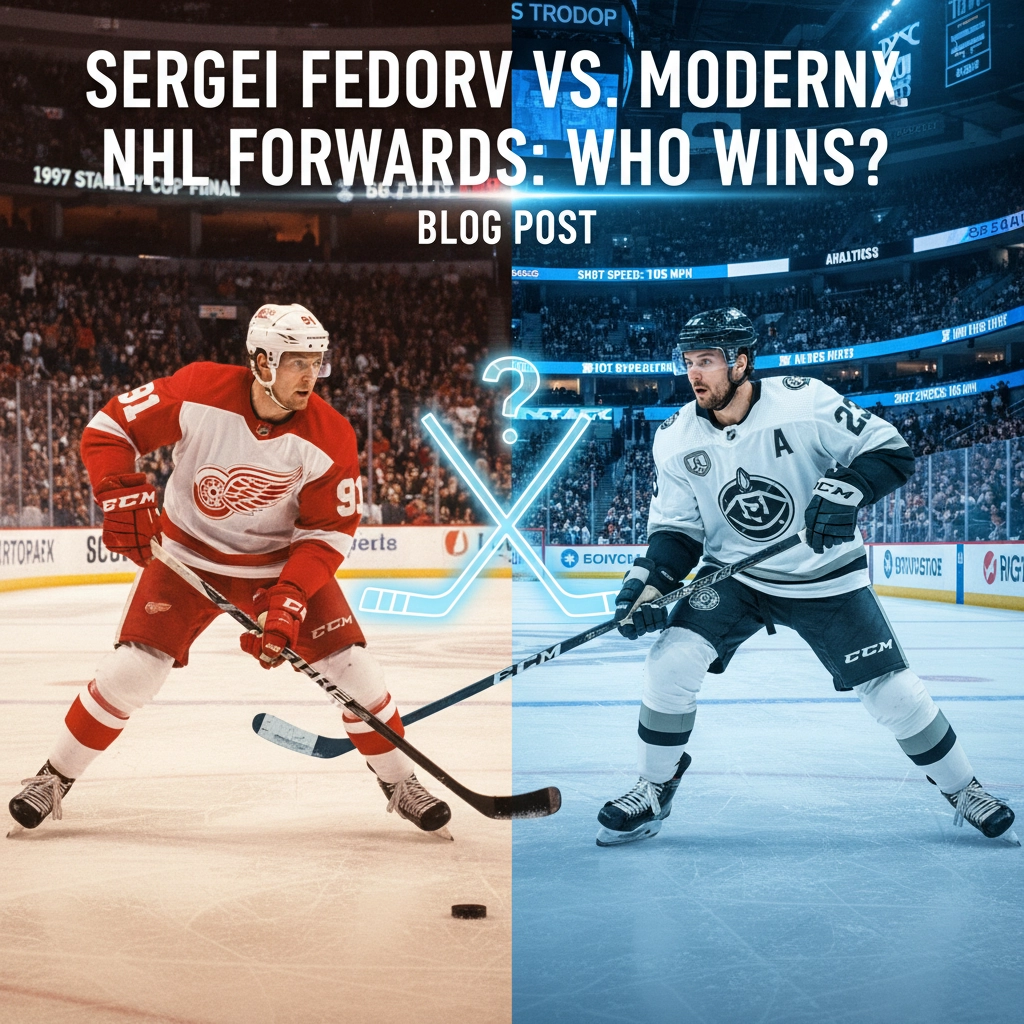
Why Sergei Fedorov’s Career Still Shapes How You Compare Players
You may already know Sergei Fedorov as one of the most versatile players of the 1990s and early 2000s—a gifted skater, playmaker, and defensive forward who changed expectations for top-line centers. To compare him to Modern NHL Forwards fairly, you need to account for the full context: the rules that governed his era, the style of play he excelled in, and the measurable traits that made him elite. That context helps you separate myth from how his specific skills would translate to today’s game.
Fedorov combined elite edgework, a lethal first stride, and unusually refined puck protection for his size. He wasn’t just offensively gifted; he logged crucial defensive minutes and killed penalties, which is a core part of why analysts still point to him when discussing two-way excellence. When you frame the comparison, ask: do you value pure offensive production most, or do you weigh all-situation value? Your answer will steer who “wins” in a hypothetical matchup.
Key Differences You Must Consider Between Fedorov’s Era and Today’s Forwards
Rules, officiating, and how they changed the pace
Officiating and rule tweaks have a major effect on how players succeed. In Fedorov’s prime, clutching-and-grabbing was more tolerated; physical board play and neutral-zone congestion were common. Modern NHL Forwards benefit from stricter interference and obstruction calls, which open lanes and reward quick transition play. When you imagine Fedorov in today’s rule environment, you should expect him to gain separation more easily—but you should also consider how defenders now prioritize speed and gap control differently.
Training, analytics, and specialization
Training today is more scientific. Players arrive in the NHL with customized strength programs, year-round skating coaches, and data-driven skill work. Modern NHL Forwards typically maximize recovery, nutrition, and performance metrics. Fedorov was ahead of his time in work ethic, but you should assume he would have benefited from contemporary conditioning and analytics, likely enhancing his endurance, shot power, and recovery between shifts.
Role expectations and roster construction
Teams now often deploy forwards in clearly defined roles: scoring lines, matchup centers, and speed-focused wings. Fedorov’s all-situation versatility made him priceless in the 1990s; in today’s game you would see coaches either push him into a top-line offensive role or exploit his defensive instincts as a shutdown playmaker. How you think a coach would use him affects the head-to-head projection against modern stars.
- Skating: Fedorov’s stride would likely remain elite and possibly even more effective with today’s skating techniques.
- Physicality: Modern forwards can be bigger and faster; physical battles might be tougher, but rule changes favor skillful skaters.
- Hockey IQ: This is timeless—Fedorov’s decision-making and vision translate directly to modern systems.
Now that you understand the situational and structural differences, you’re ready to examine direct skill matchups—how Fedorov’s hands, quickness, and defensive instincts would fare against specific modern forwards in game scenarios.
How Fedorov’s Core Skills Stack Up Against Modern Elite Forwards
When you line Fedorov up against today’s elite, the comparison comes down to which traits each player leans on. Break the fight into three axes—speed and transition, puck skills and finishing, and two-way impact—and you get a clearer picture.
– Speed and transition: Against pure top-end sprinters like Connor McDavid or Nathan MacKinnon, Fedorov wouldn’t match their raw top speed, but he would negate a surprising amount of advantage with technique. His edgework, deceptive first step, and ability to change direction make him a transition nightmare for defenders who overcommit. In quick up-ice rushes, modern superstars might still open seams that Fedorov can’t entirely close, but he would be far from outclassed; in controlled zone entries and quick puck-carry sequences, he could dictate play as well as many current top-six forwards.
– Puck skills and finishing: Fedorov’s hands and puck protection were elite for his era. Versus heavy, one-shot scorers like Auston Matthews or a powerful Finisher archetype, Fedorov’s ability to hide the puck and manufacture scoring chances with redirects, deflections, or second-effort plays would keep him competitive. He may not have the pure one-timer cannon that modern sniper profiles boast, but his high-level stickhandling and quick-release wrist shots would create volume scoring and high-danger chances—often the sort of scoring that modern analytics value beyond single-shot heat.
– Two-way impact: This is where Fedorov arguably matches or exceeds many modern forwards. Against contemporary two-way centers (think of players who log heavy defensive minutes and penalty killing roles), Fedorov’s positional discipline, spatial awareness, and ability to break up plays translate directly. Modern forwards are more specialized, but for a coach wanting an all-situation pivot, Fedorov provides the sort of possession stabilization and expected-goals suppression that analytics now prize.
Overall, against a spectrum of modern elite forwards, Fedorov is rarely overwhelmed. He may lose isolated physical or sprint battles to today’s very fastest or biggest finishers, but his combination of technique, processing, and defensive craft blunts those deficits and often makes matchups contentious rather than lop-sided.
Situational Matchups: Power Play, Penalty Kill, and Late-Game Minutes
Context determines outcomes. In special teams and late-game situations, Fedorov’s versatility becomes the deciding factor.
– Power play: Modern power plays emphasize movement, quick puck circulation, and cross-ice threats. Fedorov’s vision and passing would make him an excellent play-driving option on the half-wall or in the slot as a secondary facilitator. He may not replace an elite modern point-shot specialist, but his ability to find seams, execute timely zone entries, and thread passes to higher-percentage shooters fits perfectly with today’s motion-based systems.
– Penalty kill: This is arguably his strongest translation. Fedorov logged significant PK duty and excelled in reading plays and taking away passing lanes. In a modern penalty kill—where high-danger chance prevention is measured as much as blocked shots—his stick work, anticipation, and ability to turn defense into quick offense would be highly valuable.
– Late-game and matchup deployment: Coaches now trust analytics and matchups; a player like Fedorov, who can shut down elite opponents and still produce on the scoreboard, is a late-game premium. Whether protecting a one-goal lead or chasing an equalizer, he provides tactical flexibility that many specialized modern forwards lack.
Put simply, in the scenarios that matter most—special teams and critical minutes—Fedorov’s toolkit is inherently designed for high-leverage success in today’s NHL.
Fedorov’s Place in the Modern NHL
If coaches built a roster around adaptability and high-leverage minutes, Sergei Fedorov is the kind of player you would actively pursue. His combination of elite processing, puck protection, and defensive instincts maps cleanly onto several modern needs without requiring a wholesale reinvention of his game.
-
Matchup center — trusted against opponents’ best while still contributing offensively.
-
Special-teams pivot — a motion-friendly power-play driver and a disciplined penalty-kill disruptor.
-
Late-game specialist — someone you can deploy to protect leads or aggressively chase one in the final minutes.
Ultimately, Fedorov’s profile is one that would not only survive today’s NHL but often be prioritized in roster construction and matchup planning. For a deeper look at his career numbers and how they project, see Sergei Fedorov on Hockey-Reference.
Frequently Asked Questions
Would Fedorov need to change his training or physical style to succeed against today’s forwards?
Minor adjustments at most — modern strength and conditioning standards would likely increase his durability and ability to handle bigger opponents, but his core skill set (edge work, anticipation, puck control) already aligns with what the NHL values now.
How does Fedorov compare to strictly offensive modern stars like Auston Matthews or Connor McDavid?
He wouldn’t necessarily outpace or out-gun those generational scorers in raw speed or one-shot finishing, but Fedorov offers a different, complementary profile: playmaking, two-way impact, and situational versatility that makes him effective across more game states.
Would modern analytics favor Fedorov’s style of play?
Yes. Metrics that value possession stability, expected-goal suppression, and high-danger chance creation tend to favor players who drive play both offensively and defensively — characteristics that defined much of Fedorov’s career impact.