





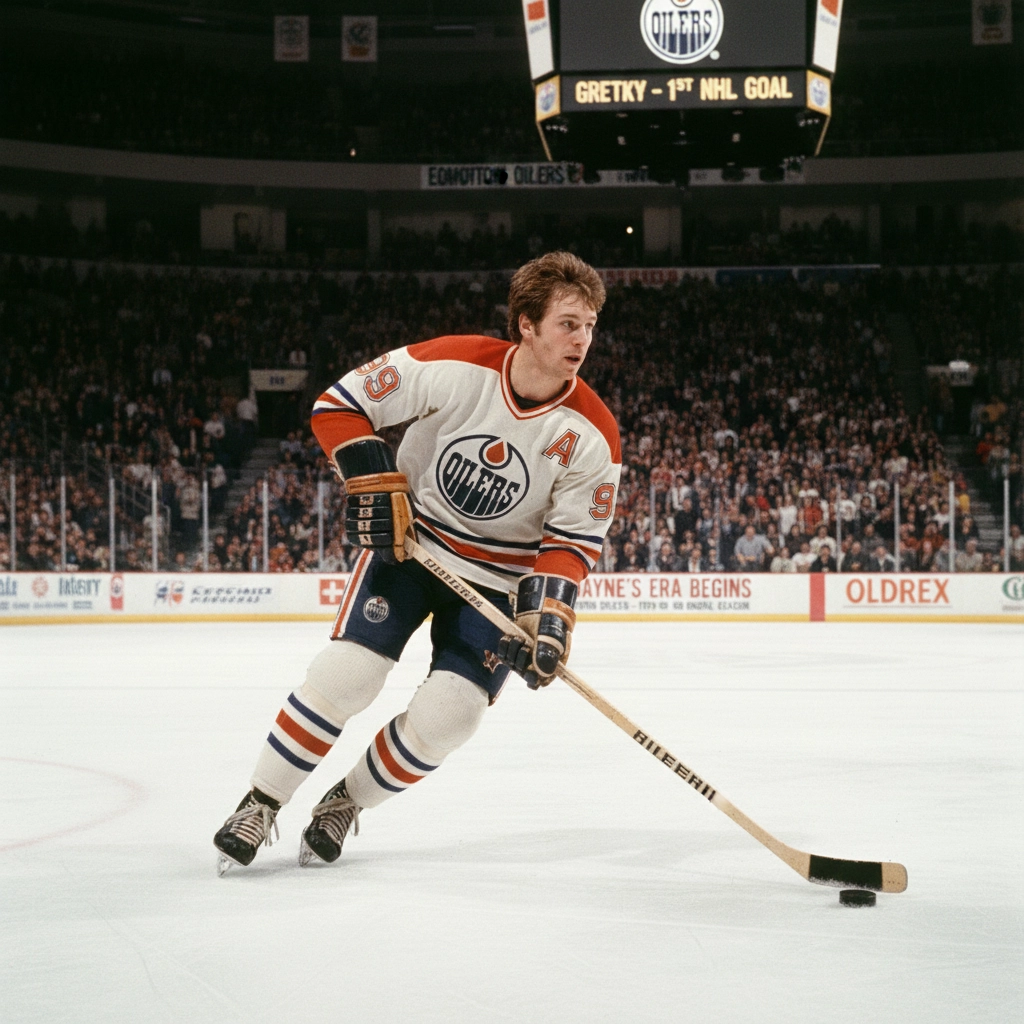
A fresh face in a shifting NHL: why Gretzky’s arrival mattered to you as a hockey fan
When Wayne Gretzky stepped onto NHL ice for the 1979–80 season, you weren’t just watching another promising youngster — you were witnessing a tectonic shift in how the game could be played. The NHL had just absorbed players and teams from the WHA, the league’s style and roster makeup were in flux, and broadcasters were beginning to bring more games into living rooms across North America. Into that environment came an 18-year-old who had already shown pro-level instincts and who would immediately turn potential into numbers that seemed to belong to a different era.
You should understand two simple facts that make his rookie year extraordinary: Gretzky was technically a “rookie” in the NHL despite earlier professional experience in the WHA, and he produced totals no first-year player had ever matched. In 1979–80 he recorded 51 goals and 86 assists for 137 points — marks that announced his arrival more loudly than any preseason hype ever could. Those totals didn’t just break records for rookies; they forced opponents, coaches, and fans to reevaluate what elite offense could look like.
How the league context amplified Gretzky’s impact
Because the NHL was adjusting to new teams and talent after the WHA merger, systems and scouting were still catching up. That created openings for a player whose strengths were anticipation, spatial awareness, and telegraphed playmaking rather than brute strength or blazing straight-line speed. You could see how those league-wide transitions made it easier for Gretzky’s style to flourish: defensive schemes were often reactive, and many teams hadn’t yet developed consistent strategies to neutralize a creative center who saw plays one or two steps ahead.
What you noticed on the ice during his first NHL season
- Elite vision: Gretzky made passes that looked obvious only to him. You would often watch him hit a teammate in stride before most defenders realized a play existed.
- Positioning over power: Instead of out-muscling opponents, he used angles and timing to be in the right spot at the right moment.
- Relentless playmaking: Those 86 assists weren’t padding; they were consistent set-ups that changed how teams defended their zone and managed the slot.
- Immediate effects on special teams: Edmonton’s power play began to revolve around finding Gretzky in dangerous areas, and you could see opponents scramble to adjust.
As you track these developments, it becomes clear that Gretzky’s rookie year was not only a statistical outlier but also a template for modern offensive thinking. The rest of the league would soon respond — adapting personnel, tactics, and coaching philosophies to contend with a player who saw the game differently — and in the next section you’ll examine how his presence reshaped the Edmonton Oilers and forced opponents to change how they built their teams.
Inside the Oilers’ locker room: building a team that fed his strengths
When you watch how a franchise responds to a transcendent talent, the internal changes are often as revealing as the on-ice adjustments. For the Oilers you could see a clear reorientation: Glen Sather and the front office stopped trying to shoehorn Gretzky into a traditional top-six template and instead built the roster to amplify his creativity. That meant faster decision-making about ice time, encouraging younger forwards to play off the puck and occupy the slot, and giving skilled defensemen license to join rushes. You didn’t need a schematic to notice the difference — it was obvious every time Edmonton’s forecheck turned into a precision counterattack once Gretzky gained possession.
You also noticed role clarity emerge. Instead of relying on size to control the crease, Sather leaned on mobility and instincts. Coaches shifted minutes so that Gretzky saw skilled wingers and dependable two-way forwards more frequently, while veteran grinders and penalty killers were deployed in situations where they could neutralize the other team’s top threats. The power play became a choreography built around finding Gretzky in pockets of space rather than hammering the blue line; on the penalty kill, the focus was on quick transition chances rather than pure obstruction. Those internal decisions turned what could have been a one-man show into a system that multiplied his effect.
Opponents’ adjustments you could see within weeks
Opposing coaches didn’t take long to respond — and their first moves were prodigiously pragmatic. You could see teams assign a dedicated checker to shadow Gretzky whenever possible, accept short-term sacrifices in offensive zone pressure to prevent his tape-to-tape passing, and add a second-layer defender specifically to clog passing lanes through the slot. Defensive pairings began to emphasize defenders who could stick with quick pivots and intercept seams rather than simply clear pucks by brute force.
Strategically, you saw a rise in reactive schemes: congestion in the high-danger areas, collapse-and-clear tactics on odd-man rushes, and more aggressive net-front physicality to disrupt Gretzky’s sightlines. Coaches also prioritized winning faceoffs in their defensive zone to limit his first-touch opportunities. Special teams flipped too — penalty kills were reorganized to eliminate Gretzky-fed cross-slot chances, and power-play units that hoped to exploit Edmonton’s youth were tempered by a newfound respect for setup-passes and off-puck movement.
What front offices began changing — a preview of the NHL’s coming shift
What you observed in the months after Gretzky’s debut was the start of a longer trend in roster construction and scouting. General managers began valuing cerebral playmaking and anticipation more clearly; size remained important, but there was a palpable premium on players who could think the game and skate it at speed. Draft boards quietly shifted: scouts paid closer attention to hockey IQ, passing vision, and spatial awareness. You also began to see more calculated trades and signings aimed at countering the new prototype — teams stocked up on checking forwards and mobile defensive options, while others doubled down on developing skilled depth to keep pace offensively.
Beyond tactical and personnel moves, Gretzky’s presence accelerated commercial and broadcast interest in star-driven narratives: teams realized that a player who could consistently create highlight-reel moments altered how they marketed games and built rosters for both competitive and financial returns. Those early reactions set the stage for how the NHL evolved through the 1980s — and they all trace back to what you watched unfold in that remarkable rookie year.
The lasting ripple of a rookie season
There’s a particular clarity in watching an inflection point happen in real time: systems bend, habits shift, and ambitions expand. Gretzky’s first season didn’t just add a spectacular scorer to the NHL ledger — it forced teams, coaches and executives to re-evaluate how hockey could be played, built and sold. That ripple persists in how teams prize vision and pace today, and it’s why a single rookie year still gets talked about as if it were a doorway into a new era. For a closer look at his career and statistics, see Wayne Gretzky’s NHL profile.
Frequently Asked Questions
How did the Oilers reorganize their roster to highlight Gretzky’s strengths?
Edmonton shifted minutes to pair Gretzky with skilled wingers, gave younger forwards clearer roles away from the puck, encouraged defensemen to join rushes, and redesigned special teams to create space and passing lanes for his playmaking instead of relying on traditional net-front size.
What immediate tactics did opposing teams use to limit Gretzky?
Opponents routinely assigned dedicated checkers, congested the slot and high-danger areas, prioritized defensive-zone faceoffs, and increased net-front physicality. Coaches also adjusted penalty-kill and power-play formations to cut off his tape-to-tape passing lanes.
Did Gretzky’s rookie year affect how teams evaluated players afterward?
Yes. Front offices began placing greater emphasis on hockey IQ, passing vision and mobility when scouting and drafting. Teams also made roster moves to add checking forwards and mobile defensemen, reflecting a broader shift toward speed and playmaking in roster construction.