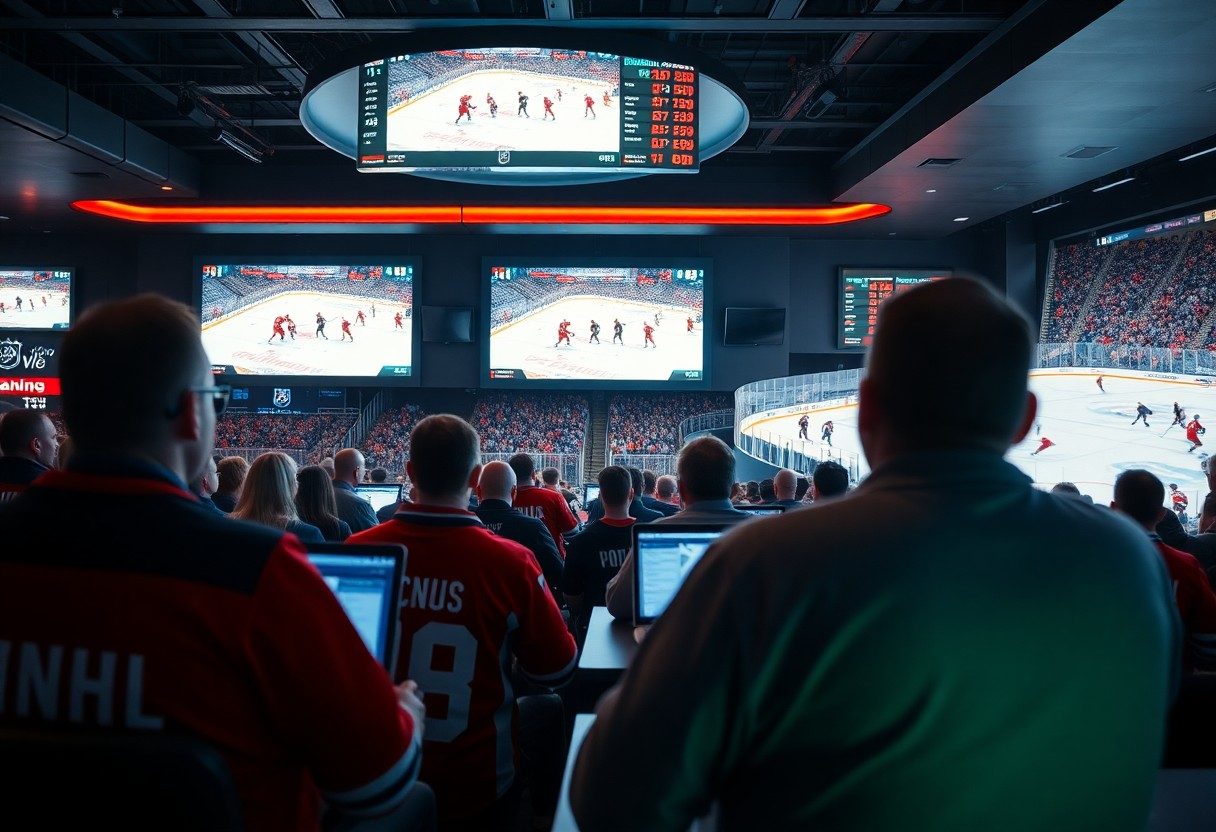









You can place a moneyline bet by simply picking the winner of a hockey match; it’s the most direct wager and pays based on odds rather than score. Understand that favorites offer smaller returns and underdogs carry bigger risk and reward, so sound bankroll management and shopping the best lines are important to long-term success.
Understanding Moneyline Betting
What is Moneyline?
Moneyline bets are a straight wager on which team wins the game; sportsbooks show them as American odds, where a favorite such as -150 means risking $150 to win $100 and a underdog like +180 pays $180 on a $100 stake, and NHL outcomes usually include overtime and shootouts in the final result, so adjust your stake and expectations accordingly.
Types of Moneyline Bets
Straight moneyline picks a winner pre-game, live moneyline shifts during play with in-game odds that can move quickly, and parlay moneylines combine multiple winners for larger payouts; sportsbooks commonly use American odds (e.g., -200, +250) to express these markets and calculate implied probability.
- Straight – single-game bet on the winner.
- Live – odds update during play and can swing after goals or penalties.
- Parlay – multiple moneylines combined for amplified payout and higher variance.
- The alternate moneyline offers shifted odds for altered payout and risk.
| Straight | Bet on winner; example: -140 = risk $140 to win $100 |
| Live | In-play odds; example: +120 after a late goal changes value quickly |
| Parlay | Combine 2+ moneylines; example: three +2.00 selections → larger payout multiplier |
| Alternate | Shifted line with different payout; example favorite -200 → alt -150 for smaller payout |
| Payout example | -150 → risk $150 to win $100 (implied 60% chance) |
Converting odds to implied probability reveals value: negative odds like -150 equate to 150/(150+100)=60%, while +200 converts to 100/(200+100)=33.3%; factor in the sportsbook vig (often 3-5%) when sizing stakes and watch how live lines react to events such as penalties or goalie pulls to identify mispricings.
- Implied probability – converts odds into a percentage to compare with your estimate.
- Vig – the bookmaker’s margin that reduces long-term ROI.
- Line movement – sharp bets or injuries can move moneylines 20-100+ points quickly.
- The bankroll strategy sets unit size (commonly 1-3%) to manage variance.
| Implied | -150 → 60%; +200 → 33.3% |
| Payout | $100 @ +180 → $180 profit; $100 @ -180 → risk $180 to win $100 |
| Vig example | -110 market on both sides ≈ 4.8% margin for the book |
| Live swing | Odds can flip from -200 to +150 after a momentum shift or empty-net goal |
| Bankroll tip | Use unit sizing (1-3%) and reduce stake when variance spikes |
Tips for Successful Moneyline Betting
Focus on line shopping, disciplined bankroll sizing and targeting value edges; for example, choosing -150 instead of -165 across parlays compounds returns, and staking 1-2% units limits volatility. Track goalie starts, day-to-day injuries, and travel-NHL home teams win about 55% overall-so small edges matter. Knowing how to prioritize these factors separates consistent winners from recreational bettors.
- Line shopping: compare odds across 3-5 books
- Bankroll: stake 1-2% units per bet
- Injuries: adjust expected minutes for absences
- Value: compare model-implied % vs market-implied %
Researching Teams and Players
Analyze last-10-game form, special teams (power-play % and penalty-kill %), and goalie metrics like SV% and GAA; a starter with SV% > .920 often flips tight moneylines. Check line deployment (top-line minutes), recent roster moves, and back-to-back travel; quantify advantages using public NHL stats and advanced analytics (Corsi, expected goals) to convert observations into a probability edge.
Understanding Odds
Convert American odds to implied probability: for -200 use 200/(200+100)=66.7%; for +150 use 100/(150+100)=40% (decimal 2.50). Always account for the bookmaker’s margin-market implied totals typically exceed 100%-and compare market implied % to your model to spot discrepancies worth betting on.
Calculate EV to confirm value: EV = P_model*(decimal-1) – (1-P_model). Example: +150 (decimal 2.5) with P_model = 50% yields EV = 0.5*(1.5)-0.5 = 0.25 (25% edge), so a $100 wager expects $25 profit. If market shows -140 (58.3%) but your model gives 64%, that gap indicates worthwhile value to stake more aggressively.
Step-by-Step Guide to Placing a Moneyline Bet
Read the moneyline and convert American odds immediately: -170 means bet $170 to win $100, while +150 means $100 wins $150. Size stakes by bankroll percentage (1-2% is common), compare prices across at least three sportsbooks, and choose pre-game or live markets based on the matchup and injuries. Track outcomes to calculate hit rate and ROI and adjust sizing when you see edge over a sample of 100+ bets.
Quick Steps & Actions
| Step | Action (example) |
|---|---|
| 1. Read the odds | Home -140 / Away +120 → $100 on +120 wins $120 |
| 2. Set stake | Bankroll $1,000 → 1% stake = $10, 2% = $20 |
| 3. Shop lines | Compare 3 books – +150 vs +165 means $15 extra on $100 |
| 4. Check rules | Verify if moneyline includes OT/shootout or is 3-way |
| 5. Place bet | Select match → choose moneyline → enter stake → confirm |
| 6. Record & review | Log stake, odds, result; calculate ROI after 100+ bets |
Choosing a Sportsbook
Prioritize a licensed book with low vig (often 4-6% on NHL moneylines), fast deposits/withdrawals, and clear rules about overtime and shootouts. Compare prices on the same market – a swing from +150 to +165 on one game can change profit by $15 on a $100 stake. Also factor promos like odds boosts or matched welcome offers up to $300-$500 when they improve long-term value.
Making Your Bet
After picking the best price, enter your stake and confirm the payout shown. For example, a $100 wager on Team A at -140 returns $171.43 total ($71.43 profit), while $100 on Team B at +120 returns $220 total ($120 profit). Double-check the market type (moneyline vs 3-way) and the displayed settlement terms before submitting the ticket.
Additional points: watch for auto-accept price changes in your bet slip (they can lock in worse odds), confirm max bet limits, and use cash-out judiciously since it often reduces expected value. Also verify whether the sportsbook settles moneylines including overtime/shootout; most US books include them, but some European sites offer separate 3-way lines.
Factors Influencing Moneyline Bets
Form, goaltending, special teams, injuries and scheduling all tilt hockey moneyline prices; a team averaging 3.2 GPG with a 25% power play and a .915 goalie will be priced differently than a club at 2.4 GPG and a .905 starter. Bookmakers also react to public money and sharp bets, moving lines when volume or model exposure is high. After, late scratches and lineup confirmations frequently produce the biggest in-game or pregame odds shifts.
- Home ice advantage – travel, last change, and crowd impact
- Goaltending – starter’s save% and recent form
- Special teams – power-play and penalty-kill percentages
- Injuries – absences of top-6 forwards or top-pair defensemen
- Schedule/fatigue – back-to-backs and travel west-to-east
- Market movement – public vs. sharp action
Team Performance and Statistics
Offense, defense and possession numbers reveal hidden value on the moneyline: teams with a 3.0+ xG per game and a +0.6 goal differential over 20 games often sustain favorite lines, while clubs with a negative PDO near 980 may regress. Evaluating recent 10-game splits, power-play success (e.g., 22% vs 14%), and goalie save% (.920 vs .905) lets you quantify expected outcomes and spot mismatches bettors overlook.
Injuries and Game Context
Missing personnel reshapes matchups fast: losing a top-6 forward who produces 0.8 points per game or a defenseman who averages 22 minutes can drop a favorite by multiple ticks on the moneyline. Situational factors like game importance, roster depth, and whether a backup has faced NHL shots recently determine whether that shift is justified and creates betting opportunity.
For example, a favorite listed at -180 that loses its starter may move toward -110 or even pick’em depending on the backup’s track record; a backup with an AHL .910 save% and limited NHL minutes is riskier than one with established NHL wins. Sharp bettors factor replacement-goalie sample sizes, line-pairing changes, and the expected goals against the projected lineup; sudden scratches within two hours of puck drop are the most dangerous signals for stale public lines and often trigger early-market exploitation.
Pros and Cons of Moneyline Betting
Simple bets meet real trade-offs: Moneyline gives a straight wager on the winner, making it ideal for quick decisions, but it also exposes bettors to skewed payouts and bookmaker margins. For example, a $100 bet on +250 returns $350, while a heavy favorite like -400 needs $400 to win $100. These contrasts define when moneyline works best and when it doesn’t.
| Pros | Cons |
|---|---|
| Very easy to understand-pick the winner | Favorites often offer tiny returns |
| No point spreads or handicaps to calculate | Bookmaker vig reduces long-term edge |
| Underdogs can produce large payouts (big +odds) | High variance when backing underdogs |
| Good for parlays and single-game bets | Line differences between books matter a lot |
| Quick resolution – winner is clear | Overtime/shootout rules can flip outcomes |
| Beginners adopt it faster than spreads | Heavy favorites require large bankroll commitments |
| Easy to calculate potential payout | Implied probabilities may be misleading without adjustments |
Advantages of Moneyline Bets
Beginners gain immediate clarity: a single number tells you how much you win or risk. Professional bettors exploit market inefficiencies-line shopping and identifying mispriced underdogs can yield value. For instance, a $100 wager on +250 pays $350, making targeted underdog staking a lucrative strategy when analytics show the book overstates favorite chances.
Disadvantages of Moneyline Bets
Heavy favorites compress value; wagering on a team at -400 means risking $400 to win $100, which magnifies bankroll strain and reduces ROI. Additionally, the bookmaker’s margin and variations in overtime/shootout rules can erode expected returns, so poor staking or ignoring implied probabilities becomes costly.
Digging deeper, implied probabilities show the bias: +250 ≈ 28.6%, -150 ≈ 60%, -400 ≈ 80%. That margin plus the vig often adds several percentage points to the book’s edge. Consistently profitable moneyline play demands disciplined bankroll management, line shopping across books, and sample sizes large enough to overcome variance from upsets and league-specific rules.
Final Words
With these considerations, the moneyline offers the simplest path to betting on a hockey match winner: pick the team you expect to win, assess odds for value, evaluate recent form, lineups and goalie matchups, manage your bankroll, and shop lines to improve returns-apply disciplined staking and objective analysis to increase long-term success.
FAQ
Q: What is a moneyline and how does it apply to hockey?
A: A moneyline is a straight bet on which team will win the game. In hockey, standard moneyline wagers typically cover the final outcome including overtime and shootouts unless the market explicitly says “regulation” or “regulation time winner.” The listed odds show which team is the favorite (negative odds) and which is the underdog (positive odds); you simply pick the team you think will win and get paid according to the odds if they do.
Q: How do I read American moneyline odds, calculate payouts, and find implied probability?
A: For positive odds (e.g., +150): a $100 stake returns $100 + $150 profit = $250 total; profit = stake × (odds / 100). Implied probability = 100 / (odds + 100) → +150 implies 100 / 250 = 40%. For negative odds (e.g., -200): you must stake $200 to win $100 profit; profit = stake × (100 / |odds|). Implied probability = |odds| / (|odds| + 100) → -200 implies 200 / 300 ≈ 66.7%. To calculate expected payout for any stake S: if odds positive, payout = S × (1 + odds/100); if odds negative, payout = S × (1 + 100/|odds|).
Q: How should I approach moneyline betting in hockey to find value and manage risk?
A: Shop lines across sportsbooks to get the best odds and always compare the implied probability to your own estimated chance of a team winning – if your estimate is higher than the market’s implied probability, the bet may have value. Factor in goalie starts, injuries, travel and rest, special teams performance, and matchup history. Manage bankroll with a fixed-percentage approach (or use a conservative Kelly fraction) rather than betting arbitrary amounts. Account for the sportsbook’s vig, and avoid overreacting to short-term variance; track results and adjust your estimates. Example EV check: if odds are +120 (implied ≈45.5%) and you estimate a 52% win chance, the bet is +EV because your win probability exceeds the market’s implied probability.