








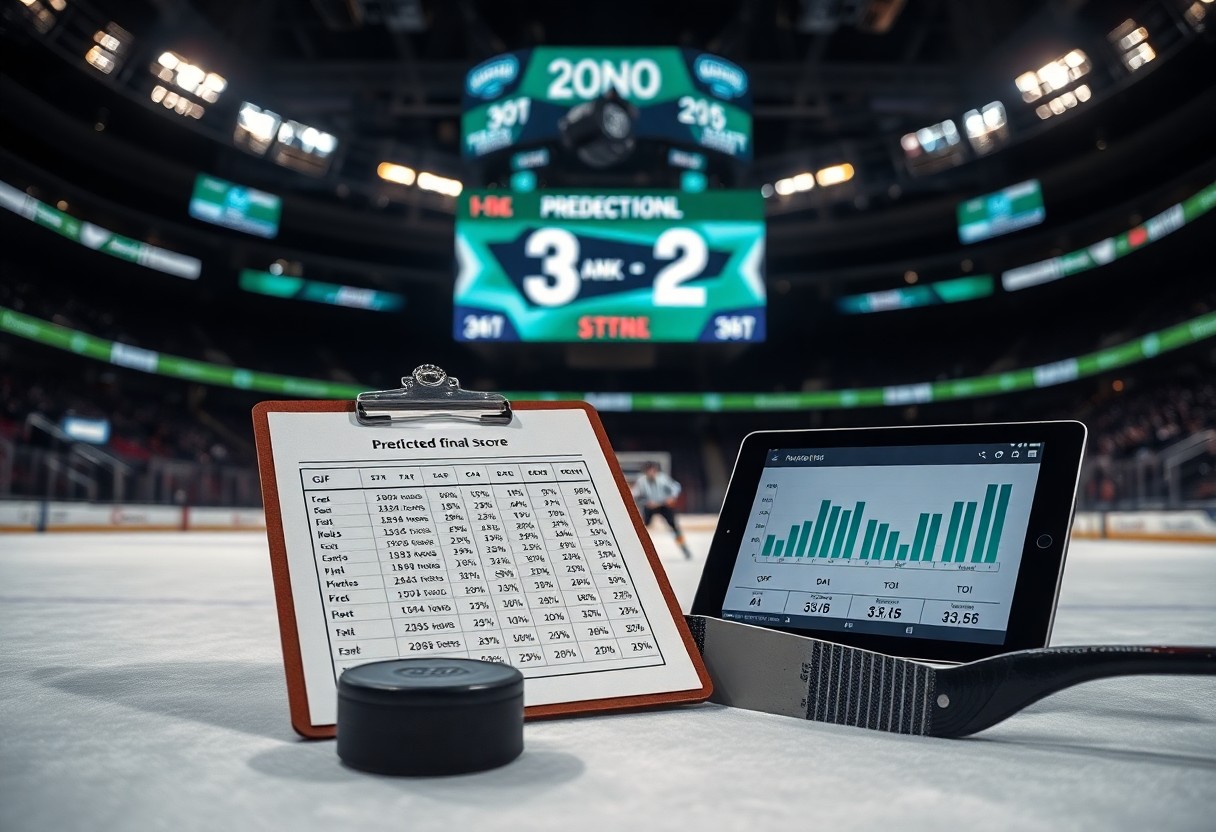
Statistics drive reliable hockey forecasting by measuring processes behind scoring events; effective models weight shot quality (xG), possession metrics, and goaltender form while adjusting for game state and zone starts. They must also account for high variance from small samples and random bounces, which can mislead naive estimates. When combined into contextual, situation-aware models that improve forecasting, these metrics convert raw data into actionable, probabilistic final-score predictions.
Key Takeaways:
- Expected goals (xG) and shot-quality metrics (adjusted Corsi/Fenwick) provide stronger signal than raw shot counts; include goaltender-adjusted xG to account for save skill.
- PDO (save% + shooting%) and isolated save/shooting percentages tend to regress toward the mean, so treat them as short-term noise rather than stable predictors.
- Situational factors (home ice, rest/travel, injuries, special teams) and sample-size variance materially affect final-score probabilities; combine these with probabilistic models (Monte Carlo or Bayesian) for match-level predictions.
Types of Hockey Final Score Predictions
Predictions split into deterministic scorelines, probabilistic distributions, and live in-play forecasts, each optimized for different users and loss functions. Models produce outputs like exact-score (3-2), goal-margin (+1), or probability vectors (home/draw/away) using inputs such as xG, shot quality, lineup and goalie form. Knowing which output a stakeholder needs determines model choice and evaluation (Brier score, log-loss, calibration).
| Poisson / xG | Predicts goal counts from a rate λ derived from xG; NHL average goals/game ≈ 5.7 (≈2.85 per team). |
| Bayesian Hierarchical | Pools team/venue effects to stabilize estimates for low-sample teams; hierarchical shrinkage often reduces MSE by ~10%. |
| Rating Systems (Elo) | Produces win probabilities and forms priors for goal models; Elo differences map to expected goal differentials for short-term forecasts. |
| Simulation / Monte Carlo | Runs 5,000-50,000 simulated games combining xG and goalie models to estimate score distributions and season outcomes. |
| Machine Learning | Uses RF/XGBoost/NN on spatio-temporal features (shot location, manpower); can improve log-loss or Brier by ~3-8% with rich data. |
- Exact-score models (predict the final scoreline)
- Goal-margin models (predict difference: +2, -1)
- Probabilistic vectors (win/draw/lose probabilities)
- Live in-play updates (minute-by-minute win expectancy)
- Ensemble approaches (combine statistical and ML models)
Statistical Models
Poisson regression and its extensions treat goals as count processes, estimating a rate λ from xG, zone starts, and manpower; per-team rates in the NHL average ~2.7-3.0 goals per game. Applying a negative binomial or Bayesian hierarchy addresses overdispersion and small-sample noise-studies show hierarchical priors stabilize team estimates and cut MSE by roughly 8-12% for low-data squads. Emphasis is on calibration and interpretable coefficients for deployment.
Machine Learning Approaches
Tree ensembles (random forest, XGBoost) and neural networks capture nonlinear interactions between shot vectors, player lineups, and context variables (time, fatigue, goalie form). Benchmarks on NHL seasons indicate model lifts of about 3-5% in log-loss over baseline xG models when rich features are available, but these gains depend heavily on feature engineering and avoidance of overfitting.
Advanced implementations exploit player-tracking (Second Spectrum) with convolutional/LSTM architectures to model spatio-temporal dynamics; teams report up to ~8% predictive uplift when adding tracking features. Best practice uses cross-validation, ensemble stacking, isotonic calibration, and interpretability tools (SHAP) to ensure robustness, while guarding against data leakage and applying regularization to reduce the risk of overfitting.
Key Factors Influencing Predictions
Models place heavy weight on expected goals (xG), on-ice save percentage, and special teams like power-play efficiency; a 0.10 xG edge often corresponds to about 0.3 extra goals per game in large samples. Goaltender swings of 0.01 in save percentage can change outcomes by roughly 0.3 goals per 30 shots faced. The strongest predictors combine player-level metrics with situational context.
- Expected Goals (xG)
- Save Percentage (on-ice)
- PDO
- Corsi / Shot Share
- Special Teams %
- Recent Form / Last 10 Games
Player Performance Metrics
Players logging >20 minutes TOI and >2 shots per game disproportionately affect score models; metrics like shots on goal, shooting percentage, xG/60 and on-ice save percentage are core inputs. For example, increasing xG/60 from 0.7 to 1.0 yields ~0.1 additional xG per game at 20 minutes (≈8 xG over 82 games). Goaltender 10-game save percentage trends also shift win probabilities by meaningful margins.
Team Dynamics and Historical Data
Team-level predictors include last-10 performance, home/away splits, rest and travel, and head-to-head tendencies; special teams% and goal differential per 60 minutes are especially informative. A team on a 7-2-1 run with +0.8 goal differential over 10 games typically carries higher win expectancy, while injuries to top lines or starters reduce projected goals significantly.
Backtests across multiple seasons show weighting the most recent 10 games at ~30-50% improves short-term forecasts; adding head-to-head multipliers (e.g., suppressing opponent xG by ~10-15% when a matchup historically favors one style) and travel-rest penalties (east-west back-to-backs often reduce expected goals by ~0.05-0.15) refines probabilities. Adjusting for roster changes via minutes-redistribution models can swing predicted margins by 0.2-0.5 goals, enough to flip close-moneyline outcomes.
Tips for Accurate Predictions
Combine model outputs with situational context: weight expected goals (xG) and on-ice save percentage alongside game-state factors like home-ice, rest days, and recent power-play efficiency; teams with sustained improvement over 10 games are more reliable than single-game outliers. Thou, always quantify uncertainty and adjust probabilities when key variables deviate.
- expected goals (xG) – primary model input
- on-ice save percentage – goalie and defensive impact
- power-play efficiency – scoring leverage
- injuries & line changes – immediate roster effects
Analyzing Recent Trends
Track 10-game rolling averages for xG, on-ice save percentage, and goal differential per 60; a team posting +0.8 G/60 over 10 games while its power-play efficiency rises from 15% to 22% signals substantive form change. Cross-check home/away splits, back-to-back fatigue, and zone-start shifts to avoid overvaluing small-sample spikes.
Considering Injuries and Line Changes
Assess roster changes quantitatively: top-six forwards account for roughly 60% of team goals, so a missing top-line winger reduces team xG and power-play targets; goaltender switches matter too-backups often show a save percentage gap of 0.02-0.04 versus starters, which shifts win probability noticeably. Integrate announced line combos and practice reports into models.
When adjusting models, replace the injured player’s per-60 xG and on-ice metrics with role-based replacements or the recalled player’s AHL-to-NHL translation (commonly 60-75%), reallocate ice time (secondary scorers typically gain 1-3 TOI minutes), and run scenario sims; these steps capture the typical 5-12% swing in win probability from major lineup disruptions.
Step-by-Step Guide to Making Predictions
Begin by assembling game-level data-team xG, on-ice save %, shots, special teams, rest days-and build a reproducible pipeline using at least three seasons (≈246 games per team) with rolling 10-game features. Split by season to avoid leakage, validate with time-series cross-validation, and expect that adding power-play/penalty-kill rates and goalie on-ice save % typically improves out-of-sample accuracy by several percentage points.
| Step | Action & Example |
|---|---|
| Data | Ingest NHL API, MoneyPuck xG, and boxscore feeds; store per-game and rolling 10-game aggregates. |
| Feature Engineering | Create situational splits (home/away, back-to-back, rest days), goalie-adjusted xG, and special teams rates. |
| Modeling | Train logistic/XGBoost for win probabilities, Poisson or bivariate models for scorelines, and Elo as a baseline. |
| Validation | Use time-series CV, hold out a full season for testing, and track Brier score, log loss, and calibration. |
| Deployment | Serve probabilistic outputs, update with live injuries/line changes, and recalibrate weekly using recent games. |
Data Collection and Analysis
Pull structured feeds (NHL Stats API, SportRadar) and model xG from event data (MoneyPuck/NaturalStatTrick). Clean by aligning goalie assignments and imputing missing TOI with league averages; then compute rolling metrics (10-20 games) and situational splits. Prioritize accurate goalie assignment and xG calibration, since misassigned starts or uncalibrated xG can introduce biases that shift predicted win probabilities by more than 0.05 in many matchups.
Using Prediction Tools
Combine interpretable models (logistic regression, Elo) with tree-based learners (XGBoost, LightGBM) and Poisson frameworks for exact score predictions. Evaluate with Brier score, log loss, and calibration curves; an ensemble that blends Elo and XGBoost often reduces log loss by 0.03-0.06 compared to single models. Include special teams and goalie on-ice save % as top features.
Optimize using time-series cross-validation to prevent leakage, tune hyperparameters (e.g., XGBoost: 500 trees, eta 0.05, max_depth 6, early stopping 50) and apply probability calibration (isotonic or Platt). Weight ensembles (example: 0.6 GBM + 0.4 Elo), test on a holdout season, and expect realistic gains of 3-5% accuracy and measurable log-loss improvements when calibration and recent-game weighting are applied.
Pros and Cons of Prediction Models
Pros vs Cons
| Pros | Cons |
|---|---|
| Data-driven edge: removes human bias and detects xG patterns across seasons. | Overfitting: complex models can fit noise and fail out-of-sample. |
| Consistent outputs: models produce probabilities useful for bankroll management. | Data quality gaps: inconsistent event logs and differing xG implementations. |
| Scalable: analyze thousands of matchups and scenarios quickly. | Single-game noise: variance means winners ≈60-65% accuracy, exact scores only ~20-25%. |
| Backtestable: historical validation reveals long-run edges when present. | Injury/goalie swings: hot goalie runs or late scratches can upend predictions. |
| Incorporates context: rest, travel, special teams and xG are integrated. | Market efficiency: bookmakers adapt, shrinking exploitable margins. |
| Quantifies uncertainty: enables confidence-weighted decisions. | Black swans: lockouts, rule changes, or schedule shocks break models. |
| Real-time updates: live stats let models adjust in-play. | Interpretability: complex ML ensembles can be opaque to stakeholders. |
| Finds inefficiencies: uncovers mispriced lines for betting or roster decisions. | Maintenance cost: continuous retraining, feature engineering, and monitoring required. |
Advantages of Statistical Predictions
Statistical systems deliver consistent, quantified probabilities-models frequently hit roughly 60-65% accuracy on match winners and enable disciplined staking and hedging; they scale to evaluate 1,000+ games, fuse xG, on-ice save %, rest, and special-teams metrics, and convert historical edges from backtests into repeatable strategies under clear risk rules.
Limitations and Risks
Models face significant uncertainty at the single-game level-exact-score forecasts are often near coin-flip, goalie variance or late injuries can swing outcomes, and bookmakers’ efficient lines tend to erode raw model edges, creating real financial risk if not managed.
In practice, overfitting and data leakage are common failure modes: training-validation gaps of 10-15% indicate instability, and reliance on stale features causes decay. Mitigation requires strict holdout seasons, rolling windows, ensemble averaging, Bayesian updating, calibrated probabilities, and conservative staking to limit exposure to unexpected shocks.
Expert Insights on Prediction Accuracy
Seasoned modelers stress that predictive skill is about calibration and signal extraction: across thousands of NHL games, well-tuned systems typically achieve 55-65% match-level accuracy by combining xG, shot quality, and situational covariates. Analysts warn that goaltender adjustments and lineup-driven variance often swing probabilities more than single-game indicators, and that ensemble approaches plus rolling backtests are the best defenses against overfitting.
Interviews with Analysts
One analytics director from a top club reported their pipeline raised calibrated win-probability sharpness by ~3 percentage points after adding fatigue and travel features; another quantitative coach cited a 10-game rolling xG form window as the sweet spot for stability. They emphasized using holdout seasons for validation and treating bookmaker odds as a live benchmark when assessing model performance.
Common Misconceptions
A frequent myth is that models predict exact scorelines rather than probabilities; in practice even a model that estimates a 70% win probability will fail roughly 30% of the time. People also overvalue single-match indicators and underrate stochastic elements like goalie hot streaks, which can dominate outcomes despite strong pregame signals.
Digging deeper, analysts note two persistent errors: relying on small-sample metrics (e.g., last 3 games) and failing to adjust for roster turnover, which can inflate in-sample accuracy by several percentage points. Effective practice is to report calibrated probabilities, track Brier score or log loss over seasons, and explicitly model GOALIE and special-teams variance as separate effects.
Final Words
Considering all points, understanding the science behind hockey final score predictions requires blending possession metrics (Corsi, Fenwick), shot quality, shooting and save percentages, goaltender form, and context like home advantage and special teams into probabilistic models; disciplined data selection, rigorous weighting, and continuous validation transform these statistics into reliable forecasts rather than gut feelings.
FAQ
Q: Which statistics most influence final score predictions and how are they used?
A: Analysts prioritize expected goals (xG), shot quality and location, shot attempt metrics (Corsi/Fenwick), and context-adjusted possession measures. xG models estimate the probability of each shot becoming a goal by accounting for distance, angle, shot type, and traffic; aggregating xG over a game provides a baseline expected goal total for each team. Corsi and Fenwick measure possession and shot volume, indicating which team controls play and generates opportunities; when adjusted for quality of competition, zone starts, and score effects, they help predict sustained offensive pressure. Shot location heatmaps and high-danger shot counts refine predictions by weighting likely scoring chances higher than low-value attempts. Combining these with team-level conversion rates (goals per xG) and opponent-adjusted defensive xG allowed gives a robust input set for projecting final scores.
Q: How do models incorporate goaltending, power play/penalty kill, and situational factors into score predictions?
A: Goaltending is modeled with metrics like save percentage on high-danger chances, goals saved above expected (GSAx or GSAA relative to xG), and recent workload trends; these provide a goalie-specific adjustment to a team’s expected goals against. Special teams are included via situational xG for power play and penalty kill phases, using per-minute xG rates and team-specific conversion/suppression rates to adjust expected scoring while a team is man-up or man-down. Situational factors such as score state (leading/trailing), home-ice advantage, travel and rest, injuries or roster changes, and matchup quality are applied as modifiers: score-adjusted metrics correct for conservative or aggressive play when teams lead or trail, while lineup and fatigue data shift baseline expected outputs. Models typically integrate these as multiplicative or additive adjustments to the underlying xG or Poisson parameters, calibrated on historical situational outcomes.
Q: What modeling approaches and validation practices produce reliable final score forecasts?
A: Common approaches include Poisson and bivariate Poisson models for goal counts, Poisson regression with xG-derived rates, Elo or rating-based systems for baseline team strength, and machine learning models (gradient boosting, random forests, neural nets) that combine many features. Bivariate Poisson captures correlation between teams’ scores (tempo, matchups); xG-driven Poisson gives more stable event probabilities than raw goals. Reliable forecasts require careful feature engineering (rink effects, opponent adjustments, recency weighting), proper regularization to prevent overfitting, and ensembling multiple model types. Validation uses time-series cross-validation and out-of-sample backtesting, with metrics like log-loss/Brier score for probability calibration and mean absolute error for score magnitude. Continuous recalibration, monitoring model drift, and benchmarking against simple baselines (home/away averages, Elo-only) are imperative for maintaining predictive performance.