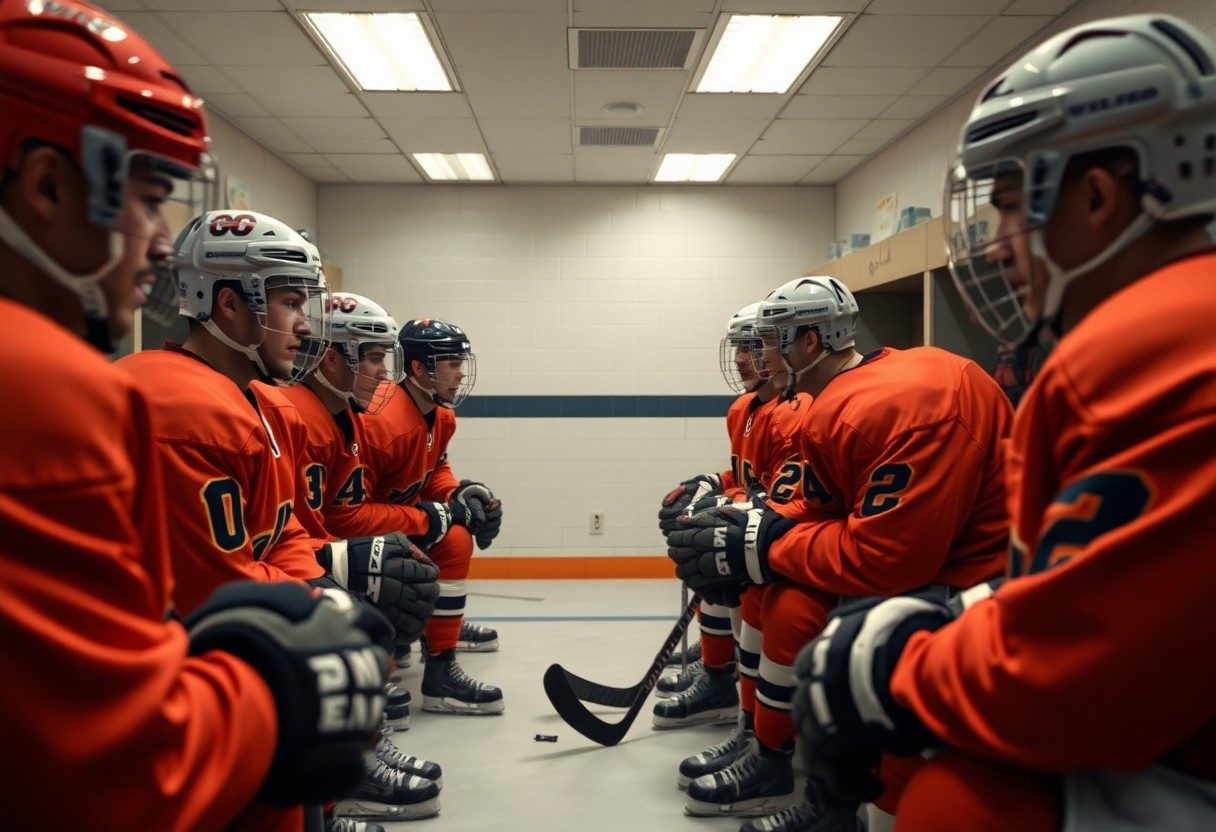









Most successful predictors combine rigorous statistical modeling with sport-specific scouting, emphasizing data-driven models and situational analysis to estimate goals and margins; they also monitor goaltender form and lineup changes as unexpected injuries and late scratches can quickly swing outcomes, while tracking positive indicators like consistent scoring trends and power-play efficiency and rest schedules improves accuracy.
Key Takeaways:
- Combine expected goals (xG) and shot-quality metrics with possession indicators (Corsi/Fenwick) and scoring-chance data, then model scoring rates using Poisson or bivariate Poisson frameworks with time adjustments.
- Adjust models for goaltender quality, injuries, fatigue and special-teams performance, applying recent-form weighting to reflect current team state.
- Incorporate market and live data-odds lines, in-game win-probability, shot clock and zone-entry updates-to capture information not present in historical stats and update predictions in real time.
Types of Hockey Games
Different formats-Professional Hockey, Junior, College, Amateur Hockey and international cups-create distinct predictive patterns: pros feature stable rosters and analytics, juniors show developmental volatility, college schedules run ~30-40 games, and amateurs have inconsistent lineups and goaltender variance, all affecting models for predicting final score in hockey games.
- Professional Hockey
- International/Pro (KHL, Euro leagues)
- Junior
- College (NCAA)
- Amateur Hockey
| NHL / Professional | 82-game regular season, stable lines, heavy analytics, average ~5-6 goals/game, predictable goaltender usage |
| KHL / International Pro | About 60 games, wider travel effects, variable officiating standards, different scoring tempos |
| Junior Leagues | High roster turnover, developmental skaters, larger variance in scoring night-to-night |
| College (NCAA) | ~30-40 games, special teams swing outcomes, smaller sample sizes affect model confidence |
| Amateur / Recreational | Irregular schedules, inconsistent goalie quality, frequent lineup changes and higher scoring dispersion |
Professional Hockey
NHL teams play 82 regular-season games with consistent usage patterns-top lines log 18-22 minutes per game and starting goalies often take 50-65 starts, which stabilizes models. Advanced metrics (xG, Corsi) and travel/rest variables improve forecasts; for example, back-to-back games increase opponent scoring by measurable margins, so weighting rest and injury reports boosts accuracy.
Amateur Hockey
Local and recreational leagues show rapid lineup shifts, goalie substitutions, and varying ice-time rules; typical adult leagues run 20-30 games, but data is sparse. Betting or model-building must account for large variance from inconsistent goaltending and unpredictable special-team frequency, which amplifies forecast error compared to pro levels.
Assume that when modeling Amateur Hockey you prioritize recent goalie appearances, roster confirmations within 24 hours, and special-teams rates from the last 5-10 games, because small datasets and lineup volatility often make intuition-driven adjustments outperform pure historical averages.
Key Factors Influencing Final Scores
- Expected Goals (xG)
- Goals per Game (GPG)
- Shots on Goal (SOG)
- Corsi / Fenwick
- Power Play % (PP%)
- Penalty Kill % (PK%)
- Goaltender Save % (SV%)
- Injuries & Lineup Changes
- Home/Away Splits
Knowing how to weight xG, recent form and injury status lets you shift model probabilities toward the variables that most often change final-score distributions.
Team Performance Statistics
Evaluate per-game metrics: GPG, xG, SOG, Corsi, PP% and PK%, plus last-10 form (e.g., 7-3) and home/away splits. For instance, a team averaging 3.1 GPG against an opponent at 2.4 GPG and an xG differential of +0.6 typically outperforms in simulations. Include PDO (sustained >1030 signals potential regression) to balance short-term luck versus skill.
Player Injuries and Lineup Changes
Injuries to top-six forwards or the starter goalie immediately alter expected goals and special teams; losing a top-line forward often reduces team GPG by ~0.3-0.6, while a backup with a .900 SV% versus a .920 starter can add ~0.2-0.3 goals allowed per game. Track practice reports and deployment to update probabilities before puck drop.
Lineup shifts cascade: moving a top defenseman changes defensive zone starts and can increase opponent xG by ~0.15-0.30 per 60; removing a primary power-play quarterback can drop PP% by 15-25% (e.g., 24% → ~18-20%), reducing expected goals on the man advantage. For modeling, apply conditional adjustments-reduce expected goals by ~0.25-0.5 for missing top-six talent, cut PP minutes/convert rate proportionally, and raise simulation variance to reflect lineup uncertainty.
Tips for Accurate Score Prediction
Prioritize models that combine recent form, goaltender performance, and special teams data rather than single-game intuition; use Poisson or negative-binomial frameworks with inputs like last 20 games GF/GA, home/away splits, and opponent-adjusted metrics. Factor travel, back-to-back fatigue, and lineup changes into probability adjustments: a rested team with top-line intact often gains ~0.2-0.4 expected goals. Knowing how to weigh goaltender form and schedule density sharpens the final estimate.
- Score prediction
- Poisson models
- Goaltender SV%
- Special teams %
- Home/away splits
Analyzing Historical Data
Analyze the last 20 games plus the previous 2-3 seasons to capture trends: compute rolling GF/GA, head-to-head splits, and home advantage (typically ~0.2-0.4 goals per team). Weight recent samples higher-use 60/40 recent-to-long-term-while adjusting for schedule strength and roster changes. Incorporate special teams rankings and goalie-season splits; a team with a 25% power play vs. an opponent at 80% PK often adds ~0.3 expected goals over a game.
Understanding Team Dynamics
Track line combinations, deployment (TOI per player), and coaching tactics: top lines frequently contribute 50-60% of scoring, so a scratched winger or a line shuffle can reduce expected goals materially. Monitor injuries, suspension impacts, and in-season role changes-these alter scoring distribution and defensive coverage more than single-game volatility.
Dig deeper by quantifying role shifts: if a team loses a 20+ minute-per-game forward who averages 0.8 points/60, project a 0.2-0.4 drop in team GF/60 unless replacement minutes offset production. Assess goaltender splits-starting goalie with a .920 SV% versus backup at .885 typically translates to a 0.4-0.6 goal swing over 60 minutes. Combine these with matchup context (e.g., opponent penalty minutes per game) to adjust expected goals; strong emphasis on line chemistry and goaltender variance separates accurate forecasts from guesses.
Step-by-Step Guide to Predicting Scores
| Step | Action |
|---|---|
| Gathering Relevant Information | Collect recent 10-game GF/GA, special-teams rates, starting goalie form, injuries, rest/travel, and head-to-head trends for context. |
| Applying Analytical Techniques | Compute team xG, adjust for venue and goalie, then model score distribution with Poisson/bivariate Poisson or simulation and backtest results. |
Gathering Relevant Information
Use rolling 10-game averages for goals for/against, split by home/away, then layer in power-play% and penalty-kill% over the season. Check the starting goalie’s last 30-day save% and workload, log injuries to top-6 forwards or top-pair defensemen, and note rest days; for example, a team missing a top-line winger and their backup goalie can swing expected goals by 0.2-0.5 per game.
Applying Analytical Techniques
Start with an xG model to value shot quality, then combine offensive xG and opponent xGA to produce expected goals per team. Feed those rates into a Poisson or bivariate Poisson to get score probabilities, adjust for man-advantage and venue, and validate by backtesting at least 1,000 historical games to detect bias and overfitting.
In practice, compute team offensive xG and opposing xGA on the same time window (e.g., 10-30 games), normalize for rink/venue effects and starting goalie save% to produce adjusted expected goals (e.g., Team A adj xG 3.10, Team B adj xG 2.45). Then use a bivariate Poisson to capture correlation (power plays and game-state effects), outputting probabilities for exact scores and totals; finally, calibrate with cross-validation across the last 2-3 seasons and flag predictions where sample sizes are small or lineup uncertainty is high, since those are the most dangerous sources of error.
Pros and Cons of Different Prediction Methods
Trade-offs hinge on data, speed, and interpretability: methods that deliver higher accuracy usually need more inputs and tuning, while lightweight heuristics work fast but miss nuance. Ensemble approaches often balance biases, and combining market signals with xG and goalie form yields the most reliable short-term forecasts. Data quality, lineups, and special-teams context frequently determine whether a method wins or fails on any given night.
| Pros | Cons |
|---|---|
| Poisson / Regression: Simple math, good baseline for low-scoring hockey, easy to interpret and fast to run. | Poisson / Regression: Assumes independence of events and often underestimates variance on power plays or empty-net scenarios. |
| Elo / Rating Systems: Adapts dynamically to team strength changes; robust with limited features and few parameters. | Elo / Rating Systems: Lacks situational detail (lineups, injuries) and can lag during rapid roster shifts. |
| Machine Learning (Tree/NN): Captures nonlinear interactions (xG × PP%) and can improve calibration when tuned on 10k+ samples. | Machine Learning (Tree/NN): Prone to overfitting without cross-validation, requires large, clean datasets and explainability tools. |
| Simulation / Monte Carlo: Models game flow and randomness; yields probability distributions, not just point estimates. | Simulation / Monte Carlo: Computationally heavier and sensitive to input assumptions (shot quality, goalie form). |
| Ensembles: Combine orthogonal signals (xG, Elo, markets) to reduce single-model bias and improve RMSE. | Ensembles: Complexity in weighting; misuse can average conflicting biases and obscure failures. |
| Betting Market Signals: Incorporates collective information and news fast; often reflects hidden lineup changes. | Betting Market Signals: Priced with vig and can reflect public bias; not a pure predictive model. |
| Expert Opinions: Capture last-minute scratches, locker-room intel, and qualitative goalie form that models miss. | Expert Opinions: Subject to cognitive biases, limited sample sizes, and variable accuracy across pundits. |
| Simple Heuristics: Fast, transparent rules (last 10 games, home/away splits) that are easy to implement. | Simple Heuristics: Overly coarse; often fail against complex interactions like fatigue plus special teams changes. |
| Goalie-Adjusted Models: Explicitly model save% and high-danger save% for stronger predictive lift on short windows. | Goalie-Adjusted Models: Goalie stats are noisy; small sample sizes (e.g., <50 starts) inflate variance. |
| Time-Series / ARIMA: Captures momentum and autocorrelation in team scoring trends over 10-30 game windows. | Time-Series / ARIMA: Assumes stationarity and often fails with roster or coaching changes disrupting trends. |
Statistical Models
Poisson-based and regression models treat goals as predictable counts and work well when calibrated with expected goals (xG), shots, and special-teams rates; integrating goalie save percentages and recent 10-20 game windows typically reduces bias. They require careful validation-cross-validation or holdout seasons-to avoid overfitting, and perform best when combined into ensembles rather than used alone.
Expert Opinions
Scouts and analysts add situational context-late scratches, travel fatigue, and matchup knowledge-that models miss; this human insight often shifts probabilities meaningfully before puck drop. When aggregated and weighted by past accuracy, expert input can correct model blind spots, particularly for short-term forecasts and injury-driven lineup changes.
To leverage experts effectively, track each source’s historical calibration using metrics like Brier score or RMSE and assign weights accordingly; for example, down-weight pundits with volatile hit rates and up-weight team beat reporters who consistently flag goalie changes. Combining expert signals with market odds and xG in a Bayesian framework yields more resilient forecasts, while logging postgame errors helps refine those weights over time.
Additional Resources for Score Prediction
For deeper analysis, combine the NHL API play-by-play with specialist sites: use MoneyPuck for precomputed xG and game simulations, NaturalStatTrick for downloadable shot CSVs and split filters, and Evolving-Hockey for player projections and WAR-these let you cross-check metrics like PDO (≈1000 league average), xGF/60, and shot-danger maps to improve calibration and out-of-sample performance.
Software and Tools
Use Python (pandas, scikit-learn, XGBoost, statsmodels) or R (tidyverse, glmnet, caret) for modeling; scrape/API with requests or nhlapi wrappers and parse with BeautifulSoup; visualize via matplotlib/seaborn, Tableau, or Power BI; maintain reproducibility with Jupyter/RStudio and Git; implement Poisson, logistic-regression xG, and gradient-boosting ensembles for robust forecasts.
Informative Websites
MoneyPuck, Evolving-Hockey, NaturalStatTrick, and HockeyViz are top references: MoneyPuck supplies pregame win probabilities and simulation outputs, NaturalStatTrick offers detailed shot tables and filters, and Evolving-Hockey provides projection models and line-level analytics-use these to validate inputs and compare modeling approaches.
Download NaturalStatTrick CSVs to build a logistic xG model using distance, angle, shot type, and rebound flags; leverage MoneyPuck’s simulations to contrast Poisson vs. Monte Carlo outcomes; and apply Evolving-Hockey projections to adjust lineup expectations-apply out-of-sample validation and version control when integrating externally sourced datasets.
Summing up
As a reminder, the best approach blends objective metrics-expected goals, shot quality, goaltender and special-teams performance-with context like injuries, schedule and home advantage; apply probabilistic models, adjust for variance and small samples, and validate predictions against out-of-sample results to produce consistent, authoritative final-score forecasts.
FAQ
Q: Which statistical metrics should I prioritize when predicting a hockey game’s final score?
A: Prioritize metrics that estimate both scoring and suppression tendencies. Start with expected goals (xG) for and against to capture shot quality, and complement with shot-volume measures such as Corsi and Fenwick to assess possession. Include team shooting percentage and goaltender save percentage to adjust raw xG into likely goals. Examine special teams rates (power play and penalty kill), home/away splits, and goals-for/against per 60 minutes to get pace context. Use rolling windows (e.g., last 10-20 games) to weight recent form while blending with season averages to avoid overreacting to small samples. Adjust for opposition quality, zone starts, and matchup-driven line deployments; convert these inputs into expected goals for each side, then translate xG into goal probabilities using an appropriate distribution or simulation.
Q: How do I factor goaltender performance, rest, and workload into a final-score prediction?
A: Treat goaltenders as a major source of short-term variance but modelable with metrics. Use high-danger save percentage and xG-against faced to quantify true impact, and compute a weighted moving average (for example, last 10 games weighted heavier than season mean) to capture current form. Incorporate workload indicators: shots faced per game, minutes in recent games, back-to-back status, and travel/rest days – increased workload and short rest raise likelihood of regression toward a goaltender’s long-term mean. When a backup starts, apply a larger uncertainty adjustment or widen prediction intervals. In practical modeling, convert adjusted goaltender and team xG into expected goals allowed for the night; then simulate match outcomes or apply distributional models, giving goaltender-adjusted expectations more weight for single-game forecasts than for season-long predictions.
Q: What modeling approaches and tools produce the most reliable final-score forecasts for hockey?
A: Combine an expected-goals engine with probabilistic score models and rigorous validation. Common approaches: Poisson or negative binomial regression on xG-derived rates, bivariate Poisson to capture score correlation, and Monte Carlo simulation that samples goal events from team-specific rate processes. Machine-learning options (gradient boosting, random forests, neural nets) can model nonlinear interactions when fed features like xG, possession metrics, special-teams rates, rest, injuries, and goalie form. Calibrate models using log loss, Brier score, and proper scoring rules; validate with rolling cross-validation and backtesting on past seasons. Use ensemble methods to blend structural models (Poisson/simulation) and ML predictors to improve robustness. Practical tools include Python libraries (scikit-learn, statsmodels, PyMC3/PyMC, xgboost) or R packages (glm, mgcv, caret, brms). Run sufficient simulation draws (e.g., 5,000-20,000) to estimate score distributions and report probabilities for exact scores, goal totals, and win/draw/loss with confidence intervals.