







Why Measuring Greatness in the NHL Is More Than a Numbers Game
The history of the NHL is, in many ways, the history of its most extraordinary players. Across more than a century of professional ice hockey, certain individuals have transcended their era, reshaped how the game is played, and left records that continue to define elite performance. Debating the greatest NHL players of all time remains genuinely compelling because no single statistic tells the full story.
Points totals, Stanley Cup rings, Hart Trophy awards, and save percentages all matter. But so does context. A forward who dominated the high-scoring 1980s faces a very different comparison standard than one who thrived in the trap-heavy late 1990s or the speed-oriented modern game. Understanding greatness requires examining what a player achieved, how they achieved it, and what the sport looked like without them.
The Statistical Foundations That Define All-Time Greatness
Before examining individual careers, it helps to understand what statistics actually measure in hockey. A player earns a point by scoring a goal or recording an assist. Career point totals are the most widely used benchmark for offensive players, though they capture only part of a complete player’s value.
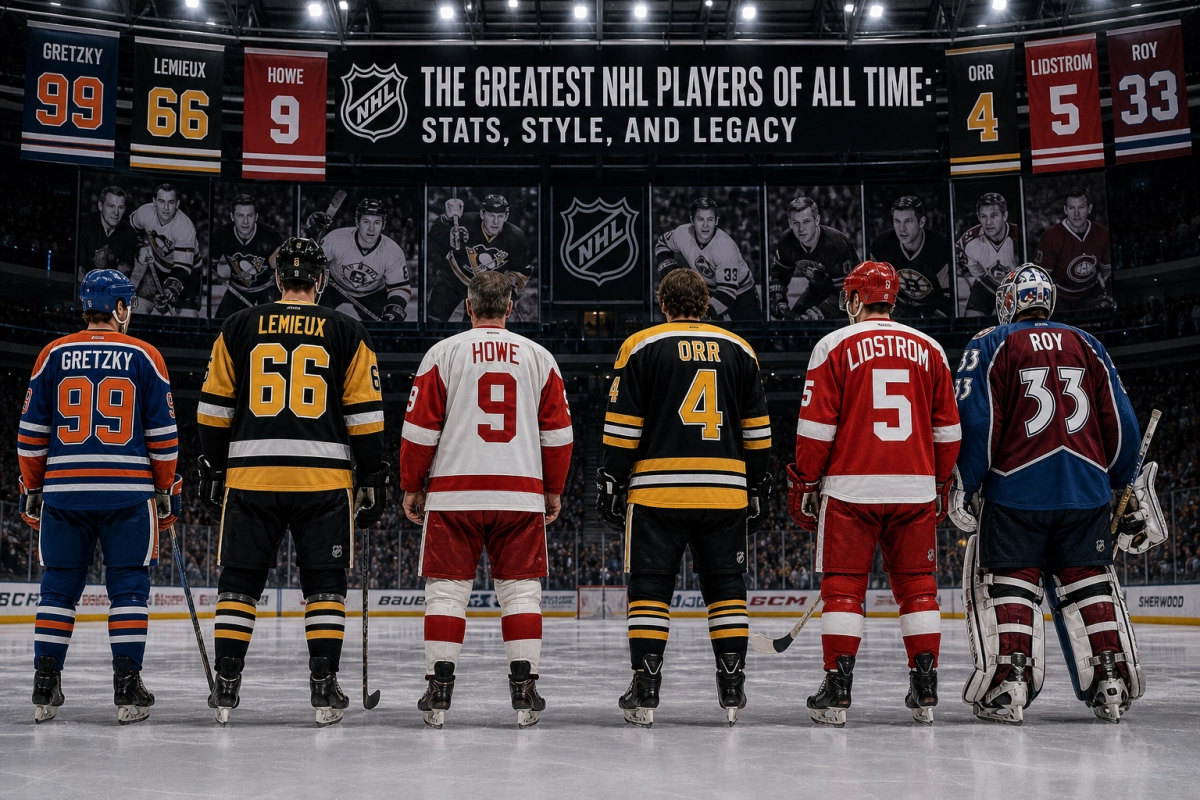
Wayne Gretzky holds the all-time scoring record with 2,857 regular-season points — a figure so far ahead of every other player that it has become almost mythological. His assist total alone, 1,963, exceeds the combined goals and assists of every other player on the all-time points list. Modern analysis also values metrics measuring defensive responsibility, zone transitions, and on-ice impact relative to teammates, which explain why some players with modest point totals remain among the best who ever played.
- Goals: The most direct measure of offensive productivity
- Assists: Reflect playmaking ability and hockey intelligence
- Points per game: Contextualises scoring across different eras and environments
- Plus/minus: Indicates on-ice goal differential at even strength
- Playoff performance: Often considered the truest test of ability under pressure
Wayne Gretzky: The Standard Against Which Every Player Is Measured
There is no honest conversation about the greatest NHL players that does not begin with Wayne Gretzky — and not simply out of tradition. The numbers demand it. Gretzky entered the NHL in 1979 and within two seasons had begun dismantling records that had stood for decades. By his 1999 retirement, he had rewritten virtually every meaningful offensive record in professional hockey history.
What made Gretzky so difficult to defend was not speed, strength, or an unusually powerful shot. His singular gift was spatial and cognitive. He processed the ice at a different speed than everyone else, understanding where the puck was going before most players recognised where it had been, and positioning himself in the spaces between defenders rather than challenging them directly.
During his peak years with the Edmonton Oilers, Gretzky posted point totals that remain incomprehensible by modern standards. In 1985-86, he recorded 215 points across 80 regular-season games — a threshold no other player has approached even once. The Oilers won four Stanley Cups during his time in Edmonton, and his presence elevated every linemate around him in measurable ways. His 1988 trade to the Los Angeles Kings was among the most consequential moments in North American sports history, opening new markets on the West Coast and directly enabling the NHL’s Sun Belt expansion into cities like Anaheim, San Jose, and Las Vegas.
Gordie Howe and the Case for a Different Kind of Dominance
A Career That Spanned Generations
Before Gretzky arrived, the name synonymous with NHL greatness was Gordie Howe. Playing the majority of his career with the Detroit Red Wings from the late 1940s through the late 1960s, Howe combined elite scoring with a physical toughness almost without parallel. He won four Stanley Cups and six Hart Trophies, led the NHL in scoring five times, and finished among the top five scorers for an extraordinary two decades. He briefly returned to the NHL with the Hartford Whalers in 1979-80 at the age of 52 — a fact that sounds apocryphal but is entirely documented.
The Howe Hat Trick and Complete Excellence
Howe’s name is embedded in the game’s folklore through the Howe Hat Trick — a single game in which a player scores a goal, records an assist, and gets into a fight. It is a half-joking tribute that nonetheless captures something real about how he played. Howe was not merely a scorer who happened to be durable; he was a force of nature who operated with the quiet confidence of someone who had never doubted his right to be there.
- Six Hart Trophy awards: Reflecting sustained dominance across more than two decades
- Four Stanley Cup championships: All won with Detroit during the franchise’s golden era
- Professional career spanning five decades: An achievement no other major North American team sports athlete has matched
- 23 All-Star selections: Underscoring his adaptability as well as his longevity
Bobby Orr and the Reinvention of the Defensive Position
If Gretzky redefined what a forward could do and Howe established the template for complete excellence, Bobby Orr did something more structurally radical — he changed what it meant to be a defenceman. Before Orr arrived with the Boston Bruins in 1966, the blueliner’s role was predominantly conservative: protect the defensive zone, clear the puck, and avoid offensive risks. Orr dissolved that boundary almost immediately.
He won the Norris Trophy as the league’s best defenceman eight consecutive times and finished in the top ten in overall NHL scoring — among all forwards and defencemen — in multiple seasons. He won the Art Ross Trophy as the league’s overall scoring champion twice; no other defenceman has won it even once. Chronic knee injuries curtailed his career significantly, and the genuine tragedy is that the player who changed hockey forever likely never reached the full ceiling of what he might have achieved. What he accomplished despite those limitations places him in any serious discussion of the two or three greatest players the sport has ever produced.
Mario Lemieux, Patrick Roy, and the Other Pillars of All-Time Greatness
Any serious historical profile must reckon with Mario Lemieux, whose career is perhaps the most emotionally resonant in the sport’s history. His combination of size, hands, and hockey intelligence was unlike anything the league had encountered — a centre who could overpower defenders physically while reading the ice with the precision of a much smaller player. What distinguishes Lemieux in historical terms is not just what he achieved but what he achieved while battling Hodgkin’s lymphoma, chronic back problems, and repeated injuries that would have permanently ended lesser careers. He retired twice, returned twice, and on both occasions proved he remained among the best players in the world. His points-per-game average sits second only to Gretzky’s on the all-time list.
In net, no conversation about the game’s greatest players is complete without Patrick Roy, who redefined goaltending in two distinct eras separated by a dramatic mid-career trade. Roy won four Stanley Cup championships across two franchises, claimed three Conn Smythe Trophies as playoff MVP, and popularised the butterfly style that now dominates the position at every level of the game. His ability to elevate in elimination games was almost supernatural, and his career save percentage and goals-against average rank among the finest in the history of the position.
The Players Who Defined Their Eras Without Owning the Headlines
Steve Yzerman and the Weight of Leadership
Steve Yzerman spent his entire 22-season career with the Detroit Red Wings and voluntarily remade himself from a pure offensive player into a two-way centre of the highest order when his team required it, surrendering personal statistics for team success with a grace that earned near-universal respect. Three Stanley Cup championships, a Conn Smythe Trophy, and the Selke Award tell only part of the story — the culture he built in Detroit during the 1990s and 2000s set the standard for what a franchise player owed his organisation.
Doug Harvey and Raymond Bourque
Before Orr restructured the position, Doug Harvey was the most complete defenceman in hockey, winning seven Norris Trophies and anchoring the Montreal Canadiens dynasty of the 1950s with puck-handling intelligence that was decades ahead of its time. Raymond Bourque accumulated more points than any defenceman in NHL history other than Orr across 21 seasons, while maintaining defensive responsibility at a level Orr’s offensive instincts sometimes required him to trade away. Bourque’s longevity, consistency, and technical excellence represent one of the most quietly extraordinary careers the sport has ever produced.
What the Greatest NHL Players Actually Have in Common
Across different eras, positions, and playing styles, a few threads connect every player who belongs in a serious all-time conversation. The first is an unusual relationship with pressure — not merely tolerating it, but consistently producing their best performances when the stakes were highest. The second is adaptability. Every player on this list survived significant changes to their sport and found ways to remain dominant through them. The third is influence that outlasted their careers.
Greatness in the NHL is not about a single statistic or a single Stanley Cup. It is about the permanence of a player’s imprint on a sport that was already extraordinary before they arrived and became measurably better because of them. That is the standard these players met, and it is the reason their names endure long after the final whistle of their last game.