







Why understanding the AHL versus European pro leagues matters for players and fans
You follow prospects, track transfers, or are simply curious about how development pathways shape the game you watch. Comparing the American Hockey League (AHL) and top European pro leagues—such as the KHL, SHL, Liiga, NLA, and DEL—helps you understand why a player’s performance in one setting may not translate directly to another. The differences go beyond geography: they influence coaching priorities, contract decisions, ice time, and the very style of play you’ll see on game night.
What you should keep in mind before reading stats
- Context matters: a point-per-game in the AHL can mean something different than the same output in Sweden’s SHL or Russia’s KHL because of role, ice time, and competition level.
- Development vs. competition: the AHL often emphasizes growth of NHL prospects; many European leagues emphasize club success and field a higher proportion of veterans.
- Environment affects performance: rink size, travel, and schedule intensity all change how players are used and how teams win.
How league structure and player pathways shape careers
You’ll notice the AHL is primarily a feeder league for the NHL. Most AHL teams are directly affiliated with NHL clubs, and two-way contracts are common—meaning players move between the AHL and NHL based on development and short-term needs. Because of that system, you’ll see AHL rosters skew younger and coaches focused on skill development, systems installation, and preparing players for an NHL style of play.
European clubs operate differently—and that changes incentives
European pro leagues vary by country, but many function as independent clubs with distinct long-term goals: winning domestic titles, qualifying for continental tournaments, or maintaining top-tier status (in countries with promotion/relegation). Rosters often blend domestic stars, older international veterans, and a handful of imports. Contracts tend to be one-way and can include clauses for transfers to the NHL or KHL. For you as a fan or evaluator, that means players in Europe might prioritize immediate team success over individual development plans.
Key structural contrasts at a glance
- AHL: NHL-affiliated, development-focused, younger rosters, frequent roster movement.
- European Pro Leagues: Club-driven, veteran presence, varied promotion/relegation systems, different contractual norms.
- Player movement: the AHL is a stepping-stone to the NHL; Europe can be a career destination or a route back to North America.
With that organizational context in mind, you’re ready to look at how on-ice conditions—rink dimensions, officiating standards, and playing style—create different types of players and statistics; the next section will break down those on-ice differences and their practical implications.
On-ice differences and how they shape play
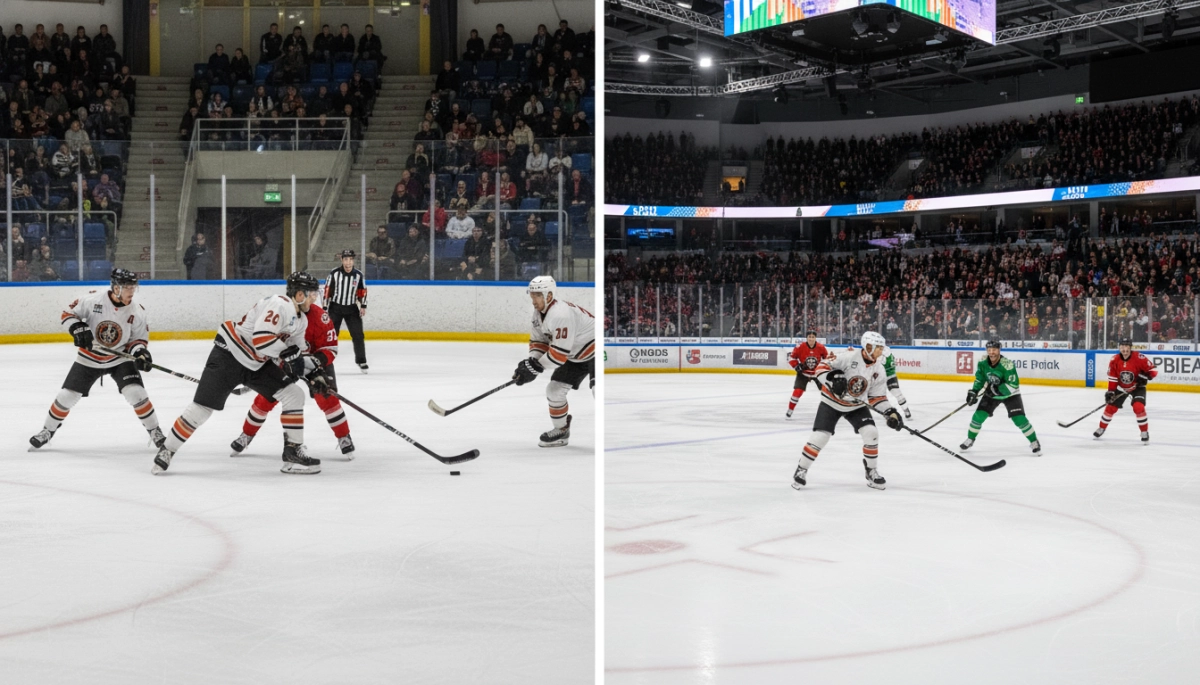
The most visible contrasts between the AHL and European leagues happen on the ice, and they change everything from the first touch to how coaches construct lines. Rink dimensions are the obvious starting point: many European arenas use Olympic-sized ice (wider and sometimes longer than North American rinks). That extra space rewards skating, lateral mobility, and playmakers who can exploit seams. In contrast, AHL games are played on NHL-sized rinks—tighter lanes, more board play, faster collisions, and a heavier premium on winning puck battles along the walls.
Officiating standards and emphasis also vary. European leagues often prioritize continuous flow and will let more contact go if it doesn’t blatantly impede play; singular enforcement trends shift by country and even by arena. The AHL, mirroring the NHL’s style, tends to police obstruction and deliver a pace that creates more high-danger, close-in scoring chances. Those differences influence power-play frequency, standing up in front of the net, and whether a team can succeed by possession or must rely on counterattacks.
There are smaller, measurable elements that add up too:
- Ice quality and boards: softer boards and different glass configurations in Europe change rebound behavior and board battles.
- Schedule intensity: AHL seasons are longer and busier, producing more fatigue; European schedules often include fewer domestic games but additional cup or continental fixtures.
- Special teams roles: in Europe, veteran specialists often take most of the man-advantage time, while in the AHL coaches use PP minutes to evaluate developing talent.
Put together, these factors produce different player archetypes. European leagues tend to hone puck protection, passing vision, and timing in open ice; the AHL can be a crash course in quick reads under pressure, physical play, and executing set plays on smaller ice.
Translating stats and scouting between the AHL and Europe
For fans and scouts trying to compare production across leagues, raw numbers are rarely sufficient. A 60-point season in Sweden, a 60-point season in the AHL, and the same total in the KHL signal different things because of role, opposition quality, ice time, and rink effects. Here are practical ways to think about translation.
- Use rate stats, not just totals: points per 60 minutes, expected goals per 60, and zone-start adjusted metrics control for ice time and deployment differences.
- Apply league equivalencies carefully: NHLe models (NHL equivalency conversions) can give a rough baseline for how productivity might scale to North American ice, but they’re blunt instruments—context and role matter.
- Evaluate skill under pressure: how does a player handle forecheck intensity, tight boards, and quick transitions? Video clips of plays in traffic and recovery efforts are often more revealing than point totals.
- Account for age and sample size: a 20-year-old lighting up a pro European league suggests higher upside than a 28-year-old veteran doing the same because developmental trajectory diverges.
- Consider goaltending context: save percentages and shot quality vary with rink size and defensive systems; a goalie’s rebound control and lateral mobility translate differently between systems.
In short: convert raw numbers into context-rich signals. Look for repeatable traits—high-end skating, decision-making speed, reliable puck retrievals—that tend to translate regardless of rink or rulebook. When statistics and scouting notes point in the same direction, you’ve got a much better read on whether a player is a true fit for North American pro hockey or a career-building asset in Europe.
Putting comparisons into practice
Knowing the differences between the AHL and European pro leagues is valuable only if you apply it. When evaluating a player, combine video from both environments, rate-based metrics, and notes on deployment rather than relying on point totals alone. Consider off-ice factors—contract type, language and culture fit, and a player’s personal goals—because they influence where a player thrives and how their career will unfold.
For up-to-date player histories, league context, and transfer details, cross-reference scouting with databases like Elite Prospects. And remember: translation is rarely a math problem; it’s an evidence-weighting exercise. The more diverse your inputs (scouting, analytics, game environment), the better your projection will be.
Key Takeaways
- Raw stats across leagues are misleading—context, role, and ice time drive true value.
- AHL development priorities produce different player types than European club-driven systems.
- Best projections come from combining video scouting, rate metrics, and league-adjusted context.