





Why Positions Matter in Professional Hockey
Ice hockey is a fast, fluid sport, and understanding how NHL players are organized on the ice is one of the most valuable things any fan or aspiring player can learn. Unlike some team sports where positions are relatively fixed, hockey demands that players read the game constantly, transition between attack and defense within seconds, and fulfill specific responsibilities that shape how their team performs.
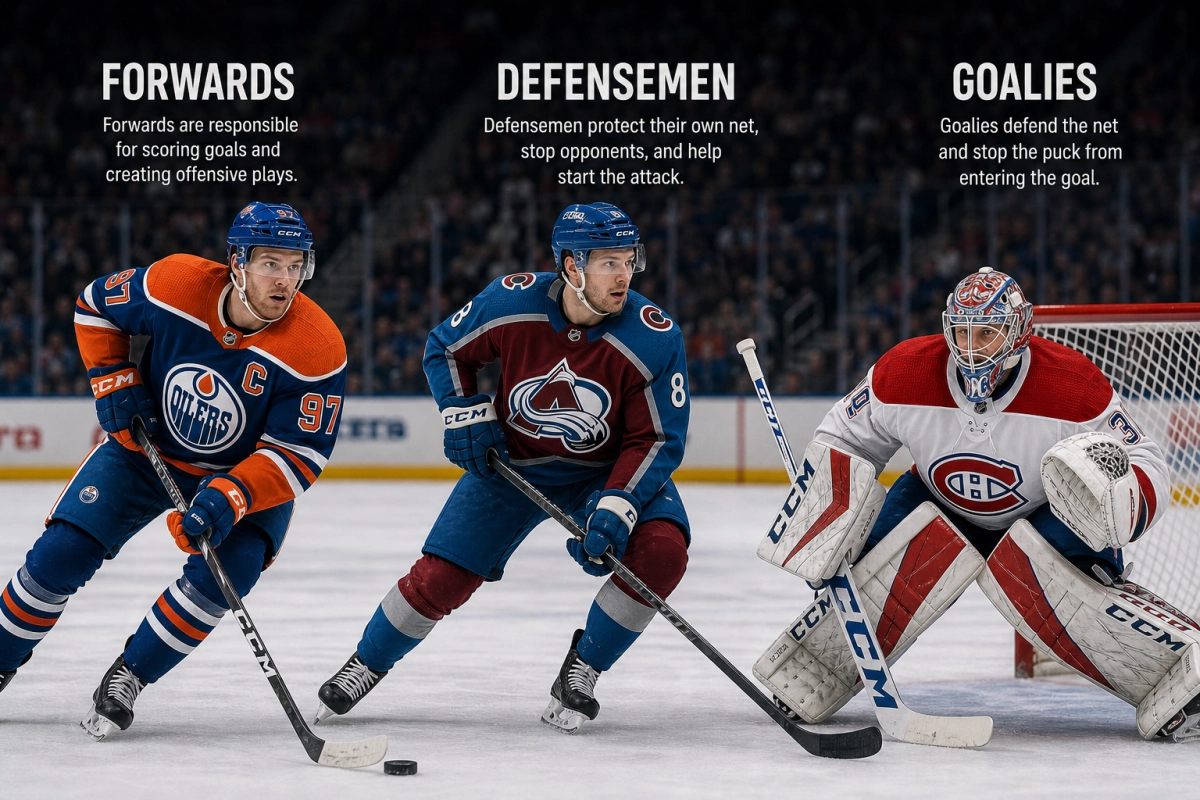
A standard NHL roster carries 20 players for any given game: 12 forwards, six defensemen, and two goaltenders. Each group operates within a distinct role, though in modern hockey those lines frequently blur. A defenseman who rushes forward to join an attack, or a forward who backchecks deep into their own zone, illustrates how interconnected these roles have become at the professional level.
What separates elite teams from average ones is rarely raw talent alone. It is the clarity with which every player understands their positional duties and the discipline to execute them under pressure.
The Forward Group: Scoring, Pressure, and Possession
Forwards make up the largest positional group and are generally the most visible players in the game. Their primary responsibility is to generate offense, but modern forwards are expected to contribute defensively just as often, and coaches build entire systems around how their forward lines move and communicate.
Centers: The Playmakers at the Core
The center is arguably the most demanding forward position in hockey. Centers line up in the middle of the ice and are responsible for taking faceoffs — where a referee drops the puck between two opposing players to start or restart play — giving them immediate influence on puck possession. Winning a high percentage of faceoffs is a key indicator of a center’s value, particularly in the defensive zone and during power plays.
Beyond faceoffs, centers serve as the connective tissue of a forward line. They link wingers on either side, distribute the puck efficiently, and are expected to both initiate attacks and drop back to help their defensemen. Players like Connor McDavid of the Edmonton Oilers exemplify this role at its highest level, combining elite skating and vision with relentless offensive instinct.
Wingers: Speed, Finishing, and Defensive Responsibility
Left and right wingers skate along the boards on their respective sides and are typically most associated with goal-scoring. Their positioning along the perimeter of the offensive zone creates shooting angles and space to receive passes, but the role carries real defensive weight too. Wingers are expected to forecheck aggressively — applying pressure in the opposing team’s zone to force turnovers — and to track back quickly when possession changes hands.
Some wingers are physical, grinding presences who wear down opponents along the boards. Others rely on speed and sharp shooting to exploit defensive gaps. Most successful NHL teams carry a combination of both types across their four forward lines.
Defensemen: The Foundation of Team Structure
Defensemen operate in pairs — left defense and right defense — and their primary obligation is to prevent the opposing team from generating clean scoring chances. NHL defensemen typically play more ice time per game than forwards, reflecting how central they are to both ends of the rink. A bad read by a winger might surrender a partial chance; a bad read by a defenseman often creates a breakaway.
Shutdown Defensemen: Structure Over Style
The shutdown defenseman is built around one principle — make life as difficult as possible for opposing forwards, particularly the opponent’s best offensive players. These players excel in one-on-one battles along the boards, use their body positioning to steer attackers away from dangerous areas, and prioritize keeping the play in front of them. Their value rarely shows up in a highlight reel, but coaches and general managers prize them accordingly.
Reading passing lanes, knowing when to challenge a puck carrier versus when to retreat, and communicating consistently with their defensive partner are skills that take years to develop. A shutdown defender who neutralizes an opponent’s top line game after game quietly tilts the competitive balance of a series.
Offensive Defensemen: Carrying the Attack from the Blue Line
The offensive defenseman is one of the most strategically valuable assets a team can possess. These players contribute from the blue line — the boundary marking each team’s defensive and offensive zones — by keeping pucks in the attacking zone, quarterbacking the power play, and generating scoring opportunities that forwards alone cannot consistently create.
What makes the role uniquely demanding is that the same instinct to join the rush aggressively can leave a team exposed if the puck turns over. The best offensive defensemen balance this tension naturally, knowing when the moment calls for aggression and when it calls for restraint.
- Power play quarterbacks control the pace from the blue line, creating shooting lanes and passing options that stretch defensive coverage
- Pinching — when a defenseman moves aggressively into the offensive zone — requires precise timing to avoid leaving the team vulnerable to a counterattack
- Offensive defensemen who also defend reliably are rare and command premium value in contract negotiations and trade markets
How Defensive Pairs Shape Team Identity
NHL teams rarely deploy two shutdown or two offensive defensemen together. The standard approach pairs players whose strengths complement rather than duplicate each other — one aggressive at the blue line, one more conservative — ensuring at least one player is always positioned to guard against the rush. A team that trusts its top pair can deploy its forwards more freely, creating a more dynamic and unpredictable offensive game.
The Goaltender: A Position Apart
No position in professional sports is quite like the goaltender. While every other player rotates on and off the bench in shifts lasting roughly forty-five seconds to a minute, the starting goaltender plays the entire game — facing somewhere between twenty and fifty shots per night, any one of which could change the outcome.
Goaltenders occupy the crease — the blue-painted area immediately in front of the net — and their fundamental task is to prevent the puck from crossing the goal line. The butterfly style, in which a goaltender drops to their knees and flares their pads outward to seal the lower portion of the net, has become the dominant technique at the professional level, prioritizing coverage of the most statistically common shooting areas.
Modern goaltenders are also expected to handle the puck with the composure of a third defenseman. Reading a dump-in and moving quickly to play the puck behind the net saves significant defensive-zone stress over a full season. Elite goaltenders like Andrei Vasilevskiy have demonstrated that puck-handling is no longer a secondary skill — it is a genuine tactical weapon.
Perhaps the most underappreciated dimension of goaltending is psychological endurance. A goaltender can play flawlessly for fifty-nine minutes and surrender a goal in the final sixty seconds that defines how the performance is remembered. Managing that reality — staying sharp, staying present, refusing to carry a bad goal into the next sequence — separates elite goaltenders from capable ones.
Reading the Game Starts with Understanding the Roles
Hockey moves faster than almost any other team sport, and that speed can make the game feel chaotic to a new viewer. But underneath the motion there is a clear structure — forwards pressing and retreating in carefully designed patterns, defensemen managing space and matchups with quiet precision, and a goaltender reading every shift from the most demanding vantage point on the ice.
Each position carries its own language of responsibilities. Centers control the tempo of possession. Wingers stretch the ice and finish chances. Shutdown defensemen neutralize threats before they develop. Offensive defensemen extend attacks and punish teams on the power play. Goaltenders anchor everything when structure breaks down and a save becomes the only answer.
What makes the NHL compelling at its highest level is not simply the athleticism on display but the way these roles interact. A line change at the wrong moment, a defenseman caught pinching when the puck turns over, a goaltender who reads a two-on-one and takes away the pass — these details, small and frequently invisible to the casual eye, decide games. The more clearly a fan understands what each player is being asked to do and why, the more rewarding the sport becomes to watch. That depth of engagement begins with the positions.