






Why Olympic Ice Hockey Stands Apart from Every Other Tournament
Olympic ice hockey represents the pinnacle of international competition. It brings together the best national teams under immense pressure, with a medal on the line and an audience stretching far beyond the usual hockey fanbase. Unlike league formats where teams play dozens of games over months, the Olympic tournament compresses everything into days. Every match carries serious consequences, and a single poor performance can end a nation’s run entirely.
Understanding the structure makes watching it considerably more rewarding. The format differs from a standard league and from the IIHF World Championship, and qualifying for the Games involves its own layered system spanning continents and multiple competitions. Olympic ice hockey also runs two separate competitions — men’s and women’s — which share venues and similar principles but differ in team numbers, qualification pathways, and competitive landscape.
How Nations Earn Their Place at the Olympic Games
Qualification is governed by the International Ice Hockey Federation. The IIHF ranks all member nations based on international results, and those rankings underpin the entire qualification system. Nations at the top of the men’s ranking — historically Canada, Russia, Finland, Sweden, the United States, and the Czech Republic — typically receive automatic berths, though the exact format varies by Olympic cycle depending on agreements with the host nation and the IOC.
For nations without automatic entry, the route runs through IIHF pre-qualification tournaments and final qualification events played in the months before the Games. Teams compete in small groups, and only the top finisher from each tournament advances. The pressure is considerable — missing out means waiting another four years.
The women’s qualification process follows a broadly similar framework, though the field at the Games has historically been smaller. Powerhouse programs such as Canada and the United States have long dominated, but European nations — particularly Finland and Switzerland — have steadily raised the standard, making qualification more contested.
- Automatic berths are typically awarded to the host nation and highest-ranked teams.
- Pre-qualification rounds reduce a larger pool of nations to a shorter list of contenders.
- Final qualification tournaments determine remaining spots, usually one team per group advancing.
- IIHF world rankings from recent World Championships carry significant weight in seeding decisions.
The Group Stage: Building Momentum and Avoiding Early Exits
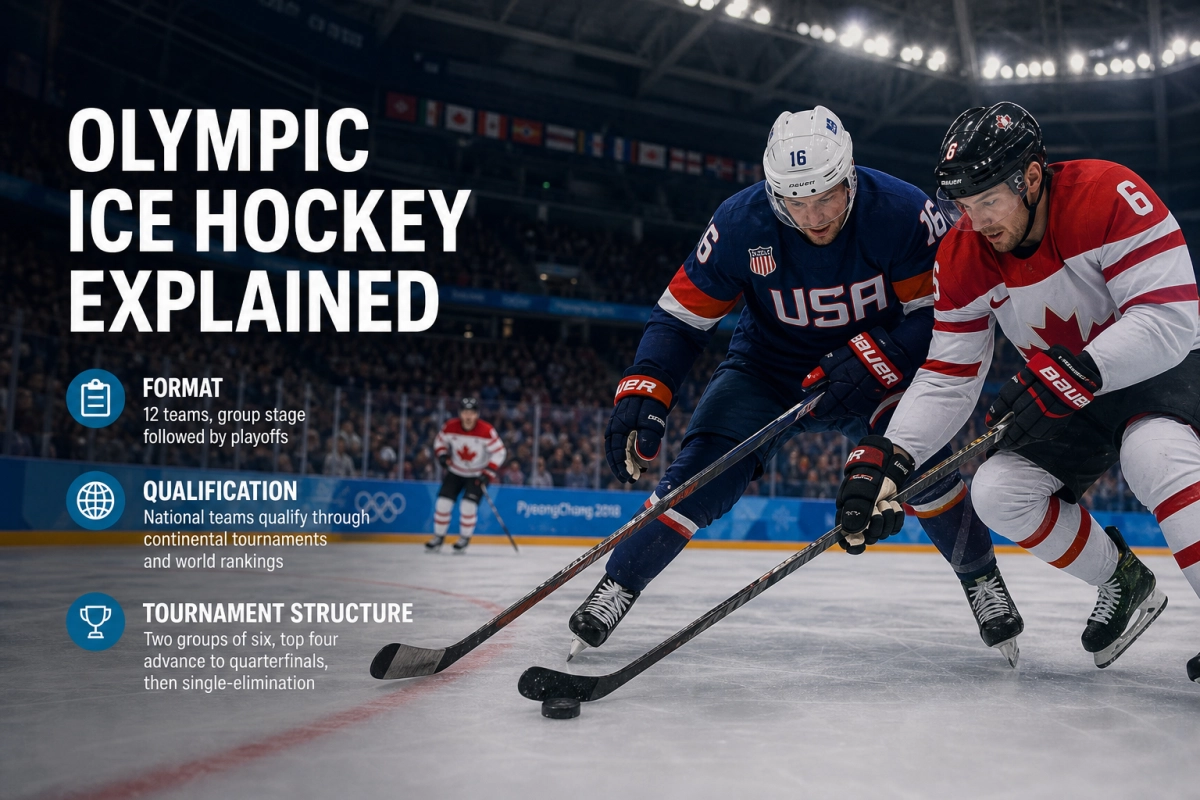
Competing nations are divided into groups for the preliminary round. In the men’s tournament, this typically means two or three groups, with each team playing every other nation in their group on a round-robin basis. Points follow a familiar structure: two for a regulation win, one for an overtime or shootout win, zero for a loss. Goal differential and head-to-head results serve as tiebreakers.
Where a team finishes in the group directly influences their seeding for the elimination phase. In a short tournament with evenly matched competition, facing a slightly weaker opponent in the quarterfinals can be the difference between a medal and an early exit. Experienced coaching staff analyse the bracket carefully and manage player workloads with this in mind.
Not every team is playing for the same outcome. Top finishers advance directly to the quarterfinals, while mid-table teams often face a qualification round — a second chance before the knockout bracket begins. Teams finishing at the bottom may be eliminated entirely, making every group stage result consequential.
Managing the Condensed Schedule
Teams may play on back-to-back days with limited recovery time. Unlike the NHL playoffs, where rest is built into the schedule, the Olympic calendar is dictated by broadcasting windows, venue availability, and the demands of hosting dozens of sports simultaneously. Coaches must rotate goaltenders strategically, manage forward lines to preserve energy, and make difficult decisions about rest. It is a genuine test of roster depth and tactical management, not just raw talent.
The Knockout Rounds: When Every Game Becomes Final
The elimination phase is where reputations are made. Once a team enters the knockout bracket, there is no margin for error — a single loss ends the run entirely. No series, no second game, no opportunity to respond. This single-elimination structure gives Olympic hockey its particular emotional intensity and produces some of the most memorable upsets in international sport.
The quarterfinals bring seeded group stage teams together against survivors of the qualification round. The four winners advance to the semifinals, and semifinal losers contest the bronze medal game rather than going home — a match many players and coaches describe as one of the hardest to prepare for mentally, requiring a full competitive effort while processing the disappointment of not reaching the final.
The gold medal final is typically played on one of the last days of the Winter Games, drawing a vast audience that includes many casual viewers who follow hockey at no other point in the year. The occasion adds a layer of pressure that no regular-season or playoff game can fully replicate.
- Single-elimination format means every match from the quarterfinals onward is decisive.
- The qualification round gives mid-table group stage finishers a second opportunity before the main bracket.
- Semifinal losers compete for bronze, preserving a meaningful final contest.
- Group stage seeding shapes the bracket path, making preliminary results strategically significant.
How the Women’s Competition Differs in Structure and Scale
The women’s tournament follows the same broad architecture — group stage, qualification round, quarterfinals, semifinals, and medal games — but the smaller field changes the rhythm of competition. The gap in performance between elite programs and developing nations has historically been wider than in the men’s draw.
Canada and the United States have met in the gold medal final at nearly every Games since women’s hockey was introduced at Nagano in 1998, a streak reflecting real structural advantages in player development, infrastructure, and funding. However, recent tournaments have seen Finland, Switzerland, and Sweden push deeper into the bracket and challenge assumptions about which nations belong in the upper tier.
The IOC and IIHF have both acknowledged the need to grow the women’s game globally. Expansion of participating teams, investment in youth development in emerging hockey nations, and the increasing professionalisation of women’s leagues have contributed to a slow but visible shift in the competitive landscape.
What Makes Olympic Ice Hockey Worth Understanding Deeply
Olympic ice hockey rewards those who understand its architecture. The qualification battles fought months before the opening ceremony, the strategic weight of a single group stage result, the brutal finality of single-elimination play, and the evolving story of the women’s competition all combine to create a tournament operating on multiple levels simultaneously.
The compressed format is what separates it most clearly from every other top-level hockey competition. There is no long season to find form, no seven-game series to correct early mistakes, and no second tournament to restore a damaged reputation. That ruthlessness is precisely what elevates the competition in the eyes of players, coaches, and fans alike.
Whether the Olympic cycle continues to evolve — with expanded fields, changing qualification pathways, or new nations emerging as genuine contenders — the essential character of the competition is unlikely to shift. It will remain a tournament built on brevity and consequence, where the margin between a gold medal and an early exit is measured not in seasons but in moments.